Musica Arte Tecnologia Storie Estreme

Archive for the 'Concettuale' Category

26

Sep

Neozoon

Scritto da:Mauro Graziani @ 2010.09.26.00.01.21 — Archiviato in: Concettuale

La street-art (graffiti et similia) è ormai storia, tanto da essere uscita dalle strade ed entrata nelle gallerie e come tale ha assunto anche caratteri di auto-celebrazione.

A mio avviso, invece, questo lavoro del gruppo berlinese/parigino Neozoon mantiene intatta una forza evocativa che sembrava perduta. Spettri degli animali che abitavano quei luoghi prima e all’alba dell’uomo, realizzati in materiali di riciclo, vecchie pellicce, parti di vestiario, scampoli di attività umana rigettata.

Oltre a quelle qui sotto, molte altre immagini sono su Flickr.

No tag for this post.

Related posts

9

Jul

AnthroPosts

Scritto da:Mauro Graziani @ 2010.07.09.22.33.50 — Archiviato in: Concettuale, Installazione

anthropostAnthroPosts organizes a growing collection of found Post-it notes in a variety of views, which colorful and symmetrical, evoke the simple beauty of a mandala. The project also features sound recordings of anonymous online workers (solicited through Amazon’s Mechanical turk) reading the notes. The inferred significance of these notes contrasts our current age of shortened communication “bursts”, and causes the viewer to find a new appreciation in the individuality of the notes themselves. Additionally, he is provided with a renewed perspective on contemporary society: it’s pace and consumption, and the double-edged sword of technology, at once enabling communication and isolating (some of) us from one another.

Noah Pedrini is a digital artist interested in exploring the changing face of community in contemporary society through interactive works.

Click the image to go.

No tag for this post.

Related posts

29

Jul

Suomenlinna Ornithological Society

Scritto da:Mauro Graziani @ 2009.07.29.04.38.36 — Archiviato in: Concettuale

logoAt the core of “Suomenlinna Ornithological Society” is the invention of new bird species with electronic birdsongs. The concrete sources of these birdsongs are samples taken from a Suomenlinna museum film about the history of the island. Explosions, cannonball whistles, and grisly vocal narrations are re-shaped into the rhythms, timbres and frequencies of birdsong. This transformation references the Electronic Voice Phenomenon (EVP), a supposedly paranormal occurrence where voices of the dead are heard via electronic technology.

The project has thus far been realized in three different forms:

  1. The Society’s Website archives the invented bird species as well as a number of real species found in Finland. A curious presence can also be detected by the inquisitive visitor.
  2. An “electro concrète” remix of the archive was commissioned by MUU Gallery for their net radio series Audio Autographs. This is an excerpt from the upcoming full-length album titled Ghost Cycle~, to be released under the moniker Suomenlinna Ornithological Society.
  3. Three small audio devices were created with the Arduino board + Waveshield by Adafruit Industries. These devices were placed in trees and gun shafts in the environment, playing the artificial birdsongs.

Project by Blake Carrington
Blake Carrington is an artist based in New York, exploring the interstices of geography and phenomenology. He recently completed residencies at HIAP in Helsinki and Atlantic Center for the Arts with Carsten Nicolai, and received an MFA in the Department of Transmedia at Syracuse University. With his two collaborators in the artist group Avalanche Collective, he co-founded Urban Video Project, a public arts initiative that used the post-industrial landscape of Syracuse as context for multimedia projections. Before coming to New York he lived in Japan for two years, working for the Japan Exchange and Teaching Programme.

View more work at http://blakecarrington.com


Tags: , ,

Related posts

25

Nov

Liu Bolin

Scritto da:Mauro Graziani @ 2008.11.25.12.26.33 — Archiviato in: Cina, Concettuale

Liu Bolin è un artista cinese che ha fatto del mimetismo la propria strategia di approccio al reale: si fonde in modo mirabile con l’ambiente, a volte scomparendo in esso, altre volte diventandone parte.

Now, in the real material world, the world views of different people’s are also different. Each person chooses his/her own way in the process of contacting outside world. I choose to merge myself into the environment. Saying that I am disappeared in the environment, it would be better to say that the environment has licked me up and I can not choose active and passive relationship.

Cliccate le foto qui sotto. Potete vedere altre immagini qui e qui. Il primo link contiene anche un suo scritto da cui è tratta la citazione di cui sopra.

No tag for this post.

Related posts

7

Jul

Jim Denevan

Scritto da:Mauro Graziani @ 2008.07.07.00.01.53 — Archiviato in: Concettuale, Land Art

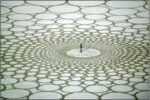
Jim Denevan è un land artist. Disegna su sabbia e su laghi salati asciutti. E disegna forme colossali interamente a mano, camminando per miglia e miglia, senza accurati strumenti di misura.

Con il suo intervento marca un luogo, stabilisce relazioni di distanza, crea un paesaggio da percepire ed esplorare in un ambiente altrimenti piatto. Un paesaggio la cui esistenza è effimera perché le sua tracce vengono cancellate dall’acqua e dal vento e alla fine non ne resta nulla.


Jim Denevan makes freehand drawings in sand. At low tide on wide beaches Jim searches the shore for a wave tossed stick. After finding a good stick and composing himself in the near and far environment Jim draws– laboring up to 7 hours and walking as many as 30 miles. The resulting sand drawing is made entirely freehand w/ no measuring aids whatsoever. From the ground, these drawn environments are experienced as places. Places to explore and be, and to see relation and distance. For a time these tangible specific places exist in the indeterminate environment of ocean shore. From high above the marks are seen as isolated phenomena, much like clouds, rivers or buildings. Soon after Jim’s motions and marks are completed water moves over and through, leaving nothing

No tag for this post.

Related posts

4

Jul

Senbazuru

Scritto da:Mauro Graziani @ 2008.07.04.01.11.41 — Archiviato in: Concettuale, Net Art

craneIn Giappone la gru è un animale mistico e si dice che possa vivere per 1000 anni.

Un’antica leggenda giapponese promette il realizzarsi di un desiderio a chiunque sia in grado di fare 1000 origami a forma di gru, chiamati Senbazuru.

Questo sito web farà i 1000 origami per voi. Esprimete un desiderio e premete Enter. Un po’ banale, ma poetico.


The crane in Japan is one of the mystical or holy beasts and is said to live for a thousand years. An ancient Japanese legend promises that anyone who folds a thousand origami cranes, known as a Senbazuru, will be granted a wish by a crane.

This website will fold a thousand cranes for you.

By Ann-Marie James

No tag for this post.

Related posts

15

Apr

Barcode

Scritto da:Mauro Graziani @ 2008.04.15.00.57.48 — Archiviato in: Concettuale, Net Art

Questo è il mio barcode.

Non c’è dentro il mio nome, ma ci sono sesso, nazionalità, età, altezza, peso.

Trattasi di un lavoro di Scott Blake:

Scott Blake takes barcodes and turns them into art - art that is simultaneously pop and op, intellectual and personal, minimal and ocular. Blake uses the black and white icon of our data-drenched existence to stimulate thought on topics from consumerism to religion and individual identity. He urges the viewer to consider the limitations of digitized human expression and to appropriate these symbols of commodity.

C’è un intero sito dedicato al lavoro di Scott Blake sui barcode.

No tag for this post.

Related posts

19

Dec

The Human Clock

Scritto da:Mauro Graziani @ 2007.12.19.00.01.50 — Archiviato in: Concettuale, Fotografia, Net Art

Questa è decisamente notevole. Una grande idea di Craig Giffen. Sono rimasto colpito a guardare la pagina per un bel po’ (sì, sono affascinato dagli orologi almeno quanto gli antichi cinesi, anche se li odio (gli orologi, non i cinesi), così come odio il tempo che passa).

The Human Clock è un orologio fatto di immagini, migliaia di immagini da tutto il mondo, ognuna delle quali ha dentro di sé un orario (ora:minuti).

Poi un software provvede a selezionare una delle foto che mostrano l’ora locale a chi si collega. C’è anche un pannello di controllo che permette di specificare la propria time zone e di scegliere fra la versione digitale e quella analogica. Semplice ed efficace.
The Human Clock esiste dal 2001, per cui forse qualcuno di voi lo conosceva già, ma internet è grande. Ora Craig Giffen è imprgnato nella realizzazione dello Human Calendar.
___________________________

Here is The Human Clock by Craig Giffen.

It’s a clock made by pictures, a thousand shots from many countries, each showing the time in the format hour:minute. Then a software selects a picture showing the local time.

No tag for this post.

Related posts

28

Nov

viral symphOny

Scritto da:Mauro Graziani @ 2007.11.28.00.01.44 — Archiviato in: Concettuale, Elettroacustica

Post-conceptual digital artist and theoretician Joseph Nechvatal pushes his experimental investigations into the blending of computational virtual spaces and the corporeal world into the sonic register.
Realtime “field recordings” of the audio manifestations of his custom created computer viruses have been reworked and reprocessed by Andrew Deutsch and Matthew Underwood, resulting in the sonic landscape of the ‘viral symph0ny’.

With resonances of Yasunao Tone, Fluxus, Oval, and Merzbow, this 28-minute composition is supplemented by a further 50 minutes of audio, comprising the original raw data field recordings.
The fully embodied CD (with 78 min. audio and art work) is for sale online here.
________________________________

Listen to:

viral symphOny (28′09″)

Joseph Nechvatal : original concept viral structures
Mathew Underwood : nano, micro, meso and macro structures
Andrew Deutsch : meso and macro structures
Stephane Sikora : C++ programming

Joseph Nechvatal site and blog

No tag for this post.

Related posts

19

Nov

MunArt

Scritto da:Mauro Graziani @ 2007.11.19.04.55.30 — Archiviato in: Concettuale

Per il centenario di Bruno Munari, un sito a lui dedicato.

Ci ho trovato questa poetica citazione di Buzzati sulle macchine inutili:

…ciascuna ha una sua speciale personalità; alcune hanno persino i loro estri bizzarri, un giorno sono vivaci e agitatissime, e il giorno dopo cadono in un incomprensibile letargo… Una volta lasciate a se stesse, le macchine inutili si sottraggono al controllo umano acquistando una esistenza autonoma e lo stesso Munari che le ha create, candido negromante, non riesce più a signoreggiarle. Ancora al buio più nero esse continuano a girare.
Noi dormiamo e loro no. Ci svegliamo e sono ancora là che ruotano, accompagnando con dolcezza l’irreparabile fuga del tempo
[Dino Buzzati, 1948]

No tag for this post.

Related posts

Next Page »