Avatar is video for a dance performance that conveys the formation of the human body into the avatar on the computer screen while it is inprocess of questionning it . Avatar exposes some occasions such as “loading” and “Disconnected” through its own way, while using the internet .
intemporalitéè un film sperimentale su Parigi realizzato a partire da un gran numero di fotografie volutamente deformate e animate.
Come al solito lamento il fatto che la parte visuale è così sperimentale, mentre la musica è più o meno la solita: semplice tonalità arricchita da effetti. Non che non ci stia, anzi segue bene il ritmo delle immagini, solo che è evidente che la ricerca è visuale e la musica è intesa come commento (peraltro ben integrato).
Film by Didier Viode
Musica: Chris Komus – Cordyceps “Cannibal in Utero”
Questo divertente video ha vinto un tot di premi. Non è particolarmente innovativo, se non nel metodo utilizzato per crearlo. Certo che, se è veramente in stop motion come sembra (ovvero un fotogramma alla volta, come nei vecchi cartoon), questi hanno lavorato un bel po’…
Katarzyna Kijek e Przemysław Adamski sono animatori polacchi che inseriscono elementi di animazione in riprese vere e proprie creando un gioco di immaginazione strettamente legato al suono.
La loro tecnica è quella dell’ormai desueta stop motion in cui viene impressionato un fotogramma per volta muovendo gli oggetti animati fra uno scatto e l’altro. Dico desueta perché la stop motion, largamente in uso un tempo, è stata ormai sostituita quasi completamente dalla grafica computerizzata. Kijek e Adamski, invece, riescono ancora a trarne situazioni di grande suggestione dove la connessione con il suono è evidente e ricca.
Dinner is Served è un interessante e leggermente inquietante slow-motion del fotografo newyorkese Craig Carson. Estraniante anche per la scelta musicale.
Nosaj Thing (born Jason Chung) è un giovane musicista di Los Angeles attivo nell’area hip hop, remix, etc.
Mi ha colpito questo video sul suo brano Eclipse/Blue per la connessione fra i due danzatori (uno reale, mentre l’altro sembra essere parte del video) e la proiezione (virtuale) alle loro spalle.
Un gioco di luci trasforma il personaggio reale in una silhouette monocromatica quasi virtuale che interagisce con una seconda silhouette la cui realtà non è chiara. Insieme generano e si fondono con le forme in evoluzione sullo schermo. Notevole.
Da quel che capisco i credit per il video dovrebbero andara a Daito Manabe, takcom, Satoru Higa, and MIKIKO with support from The Creators Project. Peraltro anche il brano non è così banale…
Grazie a Katja per la segnalazione.
UPDATE: le ballerine sono effettivamente due, una davanti e l’altra dietro allo schermo
Visibile in grandi dimensioni su Vimeo (anche su You Tube, ma io in genere preferisco Vimeo: i video sono meno oppressi dal contorno e più valorizzati. Anche la qualità video mi sembra migliore)
Art Direction: Mat Maitland
Direction: Smith & Read / Mat Maitland
Animation: Natalia Stuyk
Production: Alastair Coe at Big Active
Music: ‘Mädchen Amick’ by Buffalo Tide
Stille post è un gioco tedesco che equivale al nostro telefono senza fili, che gli anglosassoni chiamano chinese wisphers. In pratica ognuno sussurra al seguente quello che ha capito della frase sussurrata dal precedente, in una catena che può alterarne sensibilmente il contenuto.
Questo video è stato costruito in modo apparentemente analogo: ogni artista doveva creare un video di durata compresa fra 5 e 30 secondi, avente come tema il concetto di PAUSA, partendo dall’ultimo frame del video realizzato dall’artista precedente. Molto importante: ognuno non vedeva l’intero video precedente, ma riceveva solo l’ultimo frame.
Guardando il risultato si può notare come, nella maggior parte dei casi, il ricevente non si sia minimamente sforzato di sviluppare il contenuto del frame ricevuto, ma abbia cercato un modo elegante e rapido per disfarsene e piazzare la propria idea. Il che la dice lunga sull’attitudine collaborativa degli artisti in genere.
Ora non so se dirvi subito quando cambiano i video (la lista appare alla fine). Sappiate, però, che i contributi sono 13 e che due artisti non si sono adeguati alla durata massima prescritta (30″); uno ha sforato di soli 3″, ma un altro è andato oltre per ben 24″.
Ok, ecco il video. La lista dei punti di giunzione la metto dopo.
PostPanic director Mischa Rozema’s new short film, Stardust, is a story about Voyager 1 (the unmanned spacecraft launched in 1977 to explore the outer solar system). The probe is the furthest man-made object from the sun and witnesses unimaginable beauty and destruction. The film was triggered by the death of Dutch graphic designer Arjan Groot, who died aged 39 on 16th July 2011 from cancer.
The entire team at PostPanic (the Amsterdam-based creative company) pushed themselves in their own creative post techniques to produce a primarily CG short film crafted with love.
The film’s story centers on the idea that in the grand scheme of the universe, nothing is ever wasted and it finds comfort in us all essentially being Stardust ourselves. Voyager represents the memories of our loved ones and lives that will never disappear.
From a creative standpoint, Rozema wanted to explore our preconceived perceptions of how the universe appears which are fed to us by existing imagery from sources such NASA or even sci-fi films. By creating a generated universe, Rozema was able to take his own ‘camera’ to other angles and places within the cosmos.
Objects and experiences we are visually familiar with are looked at from a different point of view. For example, standing on the surface of the sun looking upwards or witnessing the death and birth of a star – not at all scientifically correct but instead a purely artistic interpretation of such events.
Rozema says, ‘I wanted to show the universe as a beautiful but also destructive place. It’s somewhere we all have to find our place within. As a director, making Stardust was a very personal experience but it’s not intended to be a personal film and I would want people to attach their own meanings to the film so that they can also find comfort based on their own histories and lives.’
Rozema turned to his regular audio partner, Guy Amitai, to create the music for the film.
I approached Guy to make the music because I trust him and knew he would instinctively understand what I wanted to communicate with this film.’ Their long-term collaboration over the years helped them explore different musical approaches before finally settling on a musical journey featuring analogue instruments. Amitai explains, Once we started working on this project and I told people about Stardust and what Arjan meant to us all, the offers started pouring in. Musician friends and friends-of-friends all wanting to join in and record even the smallest parts. It was an incredibly emotional and personal journey for us all – not something you can professionally detach yourself from.
Credits:
A PostPanic Production
Written & directed by Mischa Rozema
Produced by Jules Tervoort
VFX Supervisor: Ivor Goldberg
Associate VFX Supervisor: Chris Staves
Senior digital artists: Matthijs Joor, Jeroen Aerts
Digital artists: Marti Pujol, Silke Finger, Mariusz Kolodziejczak, Dieuwer Feldbrugge, Cara To, Jurriën Boogert
Camera & edit: Mischa Rozema
Production: Ania Markham, Annejes van Liempd
Audio by Pivot Audio , Guy Amitai
Featuring “Helio” by Ruben Samama
copyright 2013 Post Panic BV, All rights reserved
Empty America è una serie di brevi video realizzati da Thrash Lab. Si tratta di timelapse dedicati ad alcune città americane ripulite da qualsiasi presenza umana, compresi turisti e traffico.
Francamente non so bene come abbiamo fatto. Posso pensare che, essendo timelapse, quindi video non continui, ma formati da immagini a distanza di (poco) tempo montate in serie, siano state selezionati solo i fotogrammi senza persone e traffico. Però nei video ci sono anche luoghi in cui è piuttosto difficile non vedere nessuno.
Inoltre, nel video di San Francisco, c’è (secondo me) un indizio del fatto che le persone c’erano, ma sono state tolte ed è una scala mobile funzionante, ma vuota. Di solito le scale mobili si fermano quando non rilevano nessuna presenza, dopo che hanno completato poco più di un ciclo di salita.
UPDATE
Con qualche ricerca, ho trovato il making of di uno dei video. C’è dietro un notevole lavoro di Photoshop, After Effects, e Premiere. Praticamente si approfitta del fatto che il timelapse è fatto con una camera fissa. Di conseguenza, nel filmato di partenza, il posto che in un fotogramma è occupato da (per es.) un’auto, è vuoto nel fotogramma precedente o in quello successivo. In tal modo è facile prendere un frammento da un fotogramma e copiarlo su un altro per far sparire auto e persone.
Le città finora svuotate sono Seattle, San Francisco e New York. La prossima sarà Washington DC. I video hanno prodotto reazioni contrastanti. Alcuni li hanno definiti “eerily disturbing” affermando che “It feels like everyone was abducted by aliens”.
Ammetto che l’idea di un’intera metropoli come un’immensa Mary Celeste può suonare un po’ inquietante, anche perché alcuni dei casi che conosciamo sono collegati a catastrofi, tipo Pryp’yat’, ma io li trovo deliziosi. Solo la musica, in questo contesto, mi suona un po’ irritante.
URBANSCREEN è un gruppo tedesco specializzato in proiezioni di larga scala su superfici urbane.
Già famosi per 555 KUBIK – How it would be if a house was dreaming, che utilizzava come schermo la Kunsthalle Hamburg, oggi hanno ricevuto una commissione per lavorare sulla Sydney Opera House, nel quadro della manifestazione Vivid Sydney, un festival di luce, musica e idee.
Vedere le vele dell’Opera House muoversi come mosse dal vento è semplicemente emozionante.
Watch as multi-award winning German design collective URBANSCREEN transform Sydney Opera House with their Lighting of the Sails.
Vivid LIVE at Sydney Opera House is a 10-day celebration of ambitious popular music within the city’s annual Vivid Sydney festival running from 25 May to 11 June 2012.
Supersilent è una band norvegese con cui ho avuto il piacere di condividere un concerto al Göteborg Art Sound festival il 12 Maggio. Qui con Stian Westerhus alla chitarra.
Il Joshua Light Show è un team di artisti e tecnici che esiste da più di 40 anni e differenziandosi dai tanti VJ con laptop, porta avanti uno stile legato alle visioni psichedeliche dei roaring sixties, generate da proiezioni di pura luce e trasparenze imbevute di coloranti ad olio, proprio come tanti anni fa.
Visto che sembra essere scomparso dal luogo dove lo avevo linkato, ri-posto Steel Cathedrals, un breve film del 1985 di David Sylvian e Yasayuki Yamaguchi (e la voce di Jean Cocteau).
Le scene sono state girate in due giorni del Novembre 1984 vagando per zona industriale di Tokyo. La musica è stata aggiunta da Sylvian con l’apporto di altri musicisti. La formazione:
David Sylvian : keyboards, tapes, digital percussion
Steve Jansen : percussion
Ryuichi Sakamoto : piano, strings
Kenny Wheeler : flugelhorn
Robert Fripp : guitar, frippertronics
Holger Czukay : dictaphone
Masami Tsuchiya : guitar ‘abstruct’
Il video venne pubblicato su VHS in edizione limitata a 2000 copie e poi ristampato nel 1989. Anche la musica uscì dapprima solo su cassetta in un numero limitato di copie nel 1985, per approdare poco tempo dopo al CD, con qualche traccia in più.
Kapsis è frutto di una collaborazione fra Edgar Barroso, giovane compositore messicano e Yen-Ting Cho, designer di Taiwan.
Kapsis is a piece for flute, electro-acoustic music, and video art. It portrays the mesmerizing Nahua myth of a young girl who becomes a starfish. The animation will be part of a contemporary opera, which is a collaboration between composer Edgar Barroso, designer Yen-Ting Cho, and filmmaker Aryo Danusiri.
Audio/Video performance for a tryptic of HD video screens and quadraphonic audio
White Box is a work based on a new way of generating A/V compositions in real time and is a new piece in a cycle that began in 2003 with Black Box. This cycle metaphorically transposes, into sound and images, concepts from systems theory related to black, white and grey boxes.
Visuals: Yan Breuleux
Music: Alain Thibault
Programmers: Jean-Sébastien Rousseau, Peter Dines.
A Short Animation Inspired by the Works of İlhan Koman
Plato Art Space is proud to present Candaş Şişman’s video dedicated to famous sculptor İlhan Koman produced for the exhibition İlhan Koman: Hulda Festival, a Journey into Art and Science opening on the 22nd September, 2010.
İlhan Koman’s unique design approach in his form studies also inspires contemporary art works. The video installation Flux by young artist Candaş Şişman can be defined as a digital animation which is inspired from the structural features of some of İlhan Koman’s works like Pi, 3D Moebius, Whirlpool and To Infinity… A red circle, which is colored in reference to the red radiators of Ogre, is traced in a morphological transformation which re-interprets the formal approach of Koman’s works. The continuous movement sometimes connotes the formal characteristics of Pi, 3D Moebius, Whirlpool and To Infinity…, as well as the original formal interpretations of the design principles of the works . In Flux, Koman’s design process in the making of the Pi series has been treated as the emerging of a sphere from a two-dimensional circle by the principle of increasing the surface; and that simple direction is re-interpreted in digital medium. Thanks to this, in the digital animation an entirely different form serial that does not resemble Pi yet remaining its design principle can be followed through the flow of a circle to the sphere. As a conscious attitude of the artist, this work is not designed in a direct visual analogy with Koman’s works. During the animation, none of the moments of the transforming form look like Pi or 3D Moebius, however the subjective reading of Koman’s approach can be observed.
With the integration of the sounds of various materials – which Koman used in his sculptures – Flux turns into an impressive spatial experience. Flux, also exemplifies that Koman’s work can be re-interpreted by the analysis and manipulation of form in the digital medium.
Kurokawa Ryoichi composes time based sculpture with digital generated materials and field recorded sources, and the minimal and the complexities coexist there. Kurokawa accepts sound and imagery as a unit not as separately, and constructs very exquisite and precise computer based works with the audiovisual language. That shortens mutual distance, the reciprocity and the synchronization of sound and visual composition. He also performed live-visual for musicians such as HUMAN AUDIO SPONGE(ex.YMO: Sketch Show + Ryuichi Sakamoto). In recent years, Kurokawa is invited to numerous noted international festivals and museums in Europe, US and Asia including TATE MODERN[UK], ARS ELECTRONICA[AT], transmediale[DE], Shanghai eARTS[CN], MUTEK[CA], and SONAR[ES] for concert and exhibition, and he continues to be an active presence on the international stage.
Out My Window è un film e un documentario interattivo. Diretto da Katerina Cizek e girato nel corso degli anni, Out My Window esplora, con approccio novellistico, la vita in 13 luoghi diversi, sparsi per il pianeta, da Chicago a San Paolo, Bangalore e Johannesburg.
Potete scegliere quali storie vedere fra le 49 disponibili. Tutte partono da un alloggio in un edificio a molti piani (da noi sarebbe un condominio), le case ormai più comuni sul pianeta.
Bella l’idea delle gocce di inchiostro nell’acqua in questo lavoro di danio catanuto e trovo anche l’abbinamento con la musica discreto e raffinato.
L’autore:
Growth is a vision both of reality and life/growth/death. Ink drops in water are arborescences, inflorescences. Phantasmogorical images which any of us can interpret estetically on basis on one’s own uncounscious, revealing a sometimes dramatic or sometimes symbolic aestethic.
It represents the organicity and behaviour of every form of life that borns, growths and deads in its ambient, among other individuals. Some external umpredictable elements can generate, determinate and modify the course of events.
Music, here, is the scene’s sound, artificially organic, that describes and emotionally interprets the entire narrating form.
The soundscape elements represent three main aspects: the environment ambient (water), the forms’ organic developement (treated piano samples) and the presence of unpredictables and isolated events.
The whole formal aspect comes from the physics of ink drop’s expanding course.
Un altro video di Jon Weinel su cui, stavolta, abbiamo qualche informazione
This is my latest audio-visual work, a collage of different material created in Maya, Jitter, After Effects, Flash etc. It Uses hand-drawn animation as source material. The basic concept is to explore the idea of entoptic phenomena (spiral dot patterns experienced in altered states of consciousness), through the audio visual medium.
Un light show proiettato sull’Orologio Astronomico di Praga per celebrare il suo 600° compleanno. La trovo molto bella, sia dal punto di vista video che da quello del rapporto con il suono.
Da quel che ne so sono stati utilizzati due proiettori Christie Roadster 18k HD da 18000 lumen.
A light show projected onto the Astronomical Clock Tower in Praga to celebrate its 600th birthday.
Mapping: The Macula, Michal Kotek, Lukáš Duběda
Sound: data-live
Production: Tomato Production
Video artist François Vautier made an experimental film in tribute to Ridley Scott’s legendary film “Blade Runner” (1982).
This film was made as a unique picture with a resolution of 60.000 x 60.000 pixels (about 3.6 gigapixels)
It was made with 167,819 frames from ‘Blade Runner’.
The artist explain
first step : the “picture” of the film
I extracted the 167,819 frames from ‘Blade Runner’ (final cut version,1h51mn52s19i)
then I assembled all these images to obtain one gigantic image of colossal dimensions : a square of approximately 60,000 pixels on one side alone, 3.5 gigapixels (3500 million pixels)
second step : an illusion
I placed a virtual camera above this big picture. So what you see is like an illusion, because contrary to appearances there is only one image. It is in fact the relative movement of the virtual camera flying over this massive image which creates the animated film, like a film in front of a projector.
source : Blade Runner de Ridley Scott (the final cut)
duration : 1h51mn52s19i > 167819 frames >>
one picture / format psb : 60 000 X 60 000 : 3 540 250 000 pixels >> 3,5 gigapixels
compositing> logiciel : Combustion. Mac pro 2X 2.26 GHz Quad-Core Intel Xeon. nombre de layers : 1!
Note by me: 3.600.000.000 are 3.515.625 mega-pixels, so the title should be “> 3.5” not 3.6. But it’s only an academic question.
In my opinion, the interesting fact is that this is a whole film in a single image. All the 167819 frames from the film are in this mammoth image.
A music video which was derived from the visuals for the Insen Live Tour of Alva Noto & Ryuichi Sakamoto where it was generated in realtime and shown on a LED Screen on the stage.
The same music as soundtrack of a video showing the City of Berlin seen from the window of a train.
Un estratto (10 min.) dal video The Feast of Trimalchio realizzato dal collettivo russo AES+F e presentato alla Biennale di quest’anno (2009). Una fantastica visione neo-barocca degli stereotipi del lusso nel terzo millennio. Il nostro presidente del consiglio lo amerebbe perché lo prenderebbe sul serio.
Occhio (orecchio) alla musica che secondo me è inserita benissimo e agisce da elemento estraniante non banale.
Questo è il trailer
Questo, invece, è un estratto (~10 min.) di come il pubblico lo vedeva alla Biennale in una saletta con 9 schermi (girato dal vivo, si vede anche il pubblico).
Comments from the authors:
In the ‘Satyricon’, the work of the great wit and melancholic lyric poet of Nero’s reign, Gaius Petronius Arbiter, the best preserved part is ‘The Feast of Trimalchio’ (Cena Trimalchionis). Thanks to Petronius’s fantasy, Trimalchio’s name became synonymous with wealth and luxury, with gluttony and with unbridled pleasure in contrast to the brevity of human existence.
We searched for an analogue in the third millennium and Trimalchio, the former slave, the nouveau riche host of feasts lasting several days, appeared to us not so much as an individual as a collective image of a luxurious hotel, a temporary paradise which one has to pay to enter.
The hotel guests, the ‘masters’, are from the land of the Golden Billion. They’re keen to spend their time, regardless of the season, as guests of the present-day Trimalchio, who has created the most exotic and luxurious hotel possible. The hotel miraculously combines a tropical coastline with a ski resort. The ‘masters’ wear white which calls to mind the uniform of the righteous in the Garden of Eden, or traditional colonial dress, or a summer fashion collection. The ‘masters’ possess all of the characteristics of the human race – they are all ages and types and from all social backgrounds. Here is the university professor, the broker, the society beauty, the intellectual. Trimalchio’s ‘servants’ are young, attractive representatives of all continents who work in the vast hospitality industry as housekeeping staff, waiters, chefs, gardeners, security guards and masseurs. They are dressed in traditional uniforms with an ethnic twist. The ‘servants’ resemble the brightly-colored angels of a Garden of Eden to which the ‘masters’ are only temporarily admitted.
On one hand the atmosphere of ‘The Feast of Trimalchio’ can be seen as bringing together the hotel rituals of leisure and pleasure (massage and golf, the pool and surfing). On the other hand the ‘servants’ are more than attentive service-providers. They are participants in an orgy, bringing to life any fantasy of the ‘masters’, from gastronomic to erotic. At times the ‘masters’ unexpectedly end up in the role of ‘servants’. Both become participants in an orgiastic gala reception, a dinner in the style of Roman saturnalia when slaves, dressed as patricians, reclined at table and their masters, dressed in slaves’ tunics, served them.
Every so often the delights of ‘The Feast of Trimalchio’ are spoiled by catastrophes which encroach on the Global Paradise…
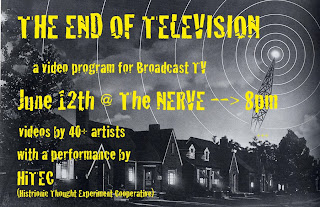
Il 12 Giugno 2009 le ultime TV americane che trasmettevano in analogico hanno spento per sempre i loro trasmettitori, passando al digitale.
Nella stessa data, The End of Television ha acceso i propri trasmettitori diventando l’unica TV analogica attiva negli USA.
Utilizzando un medium praticamente obsoleto, The End of Television ha rilanciato il mai sopito ideale del “broadcast yourself” trasmettendo una rassegna di 22 ore di video realizzati da più di 40 artisti.
The End of Television continua le proprie trasmissioni restando l’unica TV sul territorio americano visibile senza l’apposito decoder.
Energie! è un corto sperimentale di Thorsten Fleisch realizzato nel 2007.
Le immagini sono state ottenute esponendo della carta fotografica alla luce emessa da una scarica elettrica incontrollata a 30000 volts emessa da una bobina di Tesla. Le singole immagini sono state poi organizzate in sequenza.
Quindi, contrariamente a quanto si potrebbe pensare, si tratta di un prodotto che utilizza una tecnologia quasi obsoleta per creare delle immagini altamente sperimentali.
La musica è di Jens Thiele.
An evolving, resonating journey through splintering landscapes and mysterious characters. Abstractions and forms are reverberated in fragile soundscapes of chaotic planes and unsettling arrhythmic patterns. Is it film or an improvised VJ cut-up? Is it visualized music feeding back into images, or images generating music? SYNKEN pushes the limitations and restrictions of genres. Synchronized sinking as SYNKEN is Transforma and O.S.T.’s collective creative experience.
With a mix of abstract images, graphic animation, digital image effects and complex film sequences, SYNKEN creates a fantastically spaced out, darkly romantic image-world. Forests filled with distorted organic forms are contrasted against an architectural abyss, as strange and fantastic characters try to make sense of their surroundings. A mysterious vagabond works as a medium between these parallel worlds, transporting artefacts that become recurring symbols in the dual system and means of communication between the creatures which inhabit them.
Produced in parallel to the images, O.S.T.‘s arrhythmic crackling electronic 5.1 surround soundtrack bathes the images in an eerily hypnotic flow. As sound and image merge and fall apart again over time, they form a synergy that opens up subtle leads which can never be read only as linear. As plot fragments refract and reoccur, SYNKEN continuously confronts the viewer with a modular narrative that can be potentially combined to create any number of interpretations. in the live performance version, Transforma and O.S.T.‘s real-time decisions will use this potential to develop further one-off versions of SYNKEN.
O.S.T.
American electronic music maverick O.S.T. has been releasing and performing since 1992 as O.S.T., rook vallade, Dalglish, and other aliases. After more than 10 albums and numerous singles under his various monikers, Douglas remains well outside the established parameters of electronic music. His work is a malevolent mutation of techno into arrhythmic patterns, interwoven digital textures, and amorphous melodies. He is known, somewhat notoriously, as an artist who is unrelentingly true to what creativity, emotion, and passion are to music. In 2003 O.S.T. was invited by Autechre to play at their curated All Tomorrows Parties. After performing around Europe he decided to settle in Berlin where after a few years of coming down, he uses this project to start again.
Transforma
Berlin video artist collective Transforma (Baris Hasselbach, Luke Bennett and Simon Krahl) combine the momentum of VJ improvisation with the power of highly composed imagery and narrative. Transforma started producing experimental video art in 2001 and have been taking their imageworld and production processes to higher levels of absurdity ever since. They have worked on promos, concert video and live cinema approaches, in collaboration with Apparat and Funkstörung among others, and have VJed in clubs in Berlin and around Europe.
Infine parliamo anche di William S. Burroughs (1914 – 1997), uno degli scrittori che amo di più.
Ah Pook Is Here (trad. È arrivato Ah Pook, SugarCo) era stato progettato in origine (1970) come un libro illustrato sul modello dei superstiti codici maya. L’artista inglese Malcolm Mc Neill doveva disegnare le illustrazioni e Burroughs il testo.
Cominciò ad essere pubblicato con il titolo di The Unspeakable Mr. Hart sotto forma di fumetto sulla rivista Cyclops. Quando Cyclops chiuse, Burroughs e Mc Neill continuarono a sviluppare il progetto che divenne un libro fatto di testo e immagini di circa 120 pagine, alcune delle quali erano solo testo, altre solo immagini e altre ancora miste. In questa versione venne pubblicato nel 1971 da Straight Arrow Books in San Francisco.
In seguito (1973-1975), Mc Neill raggiunse Burroughs in America per continuare a lavorare al libro, ma nel frattempo Straight Arrow Books chiuse e i due non riuscirono a trovare un editore per quest’opera dal formato così strano di cui alla fine, nel 1978, venne pubblicato il solo testo. La versione italiana è interessante perché contiene anche varie pagine di illustrazioni, sia pure in formato ridotto.
Ah Pook del titolo è una translitterazione di Ah Puch, dio della morte nella cultura Maya e re di Metnal, il nono livello del mondo sotterraneo Xibalba, luogo di oscurità e freddo. L’intero testo è sulla morte e come altri testi di Burroughs, è incredibilmente ricco di idee e suggestioni, tanto da ispirare altri artisti.
Qui, infatti, vediamo un breve film di animazione diretto da Philip Hunt nel 1994 con l’ormai famosissima voce di Burroughs e la musica tratta dall’album “William S. Burroughs – Dead City Radio“, Track 4 – “Ah Pook The Destroyer / Brion Gysin’s All-Purpose Bedtime Story“, composta ed eseguita da John Cale.
Il film rappresenta bene parte dell’universo immaginifico e paranoico di Burroughs ed è stato premiato al Dresden Film Festival 1995 e all’Ottawa International Animation Festival 1994.
L’ultimo video dei Radiohead, “House of Cards”, è stato realizzato senza videocamere e luci e tuttavia non si tratta di una scena completamente ricostruita al computer. Al contrario, è ricco di elementi reali.
Sono state utilizzate alcune recenti tecnologie di scannerizzazione tridimensionale che acquisiscono informazioni sulle forme e le distanze degli oggetti, generando una serie di dati che costituiscono una descrizione geometrica della scena analoga a quella di plotting 3D.
Non si tratta di una immagine tradizionalmente intesa, cioè una foto digitale, ma della posizione di una serie di punti a partire dai quali si genera l’immagine tramite un rendering.
Si capisce molto meglio guardando il video: si vede benissimo che l’immagine è un insieme di singoli punti.
Notate anche come, alla fine del video, mentre l’ultimo accordo sfuma, anche parte dell’immagine si sfaldi con i punti che fuggono via.
Il vantaggio di questa tecnica è che la scena non è fissa, ma si può manipolare, ruotare, vedere da diversi punti di vista, entrarci dentro, etc: tutte le cose che normalmente sono possibili con i software di 3D rendering.
John Kannenberg’s Autumn Enso is a long-form video painting. Originally premiered at the 2006 Spark Festival in Minneapolis, this quietly evolving series of images combines still photography, video, traditional drawing and meticulously manipulated animation with a live performance of the original album’s sonic source material. Inspired by the circular enso paintings of zen buddhism, Autumn Enso’s delicate balance between representation and abstraction immerses the viewer in a celebration of the cyclical nature of the autumn season.
_______________________________________
Un video sui colori dell’autunno, con musica e immagini, realizzato da John Kannenberg e pubblicato dalla netlabel stasisfield.
Suguru Goto is a composer/performer, an inventor and a multimedia artist and he is considered one of the most innovative and the mouthpiece of a new generation of Japanese artists. He is highly connected to technical experimentation in the artistic field and to the extension of the existing potentialities in the relation man-machine. In his works the new technologies mix up in interactive installations and experimental performances; he is the one who invented the so called virtual music instruments, able to create an interface for the communication between human movements and the computer, where sound and video image are controlled by virtual music instruments in real-time through computers. Lately, he has been creating the robots, which perform acoustic instruments, and he is gradually constructing a robot orchestra.
Di Suguru Goto vi presentiamo due video. Il primo, “Robotic Music”, presenta dei robot percussionisti cioè il tipo più studiato, essendo il più semplice da costruire e controllare (e il termine “semplice” è riduttivo perché si tratta sempre di una faccenda complessa).
Qui il valore musicale è relativo, essendoci anche un importante lavoro di ricerca. In ogni caso, come solo di batteria non è poi male.
Il secondo, invece, è una performance più complessa in cui un esecutore umano che veste una tuta che incorpora dei sistemi di controllo, “dirige” una esecuzione robotica e interagisce con un video in cui una figura parzialmente umana esegue le sue stesse mosse.
I due, un corpo “aumentato” e un corpo virtuale, sono praticamente complementari.
L’aurore afferma:
“Augmented Body and Virtual Body” is conceived as a music theater piece, that the elements cross and hybridize themselves in continual links/ratios of exchanges and flow without fixing itself towards any directions. The idea would be that what is real, which is artificial, what is virtual, on the verge of themselves, and to create relations of pure intensities, which degrees zero of expression without its value of positive or negative.
Il Ballet Mécanique (1924) era un progetto del compositore americano George Antheil (che viveva a Parigi) e del filmaker Fernand Léger, con la partecipazione di Man Ray.
Dal punto di vista musicale, si trattava di un brano per strumenti meccanici che suonano senza intervento umano. Visti i tempi, è un’idea tipicamente dadaista, come del resto è il film
Tuttavia è difficile dire chi dei due lavorò sull’opera dell’altro. Léger affermò di aver iniziato il film già nel 1923, ma altre fonti dicono che fu lui a contattare Antheil quando quest’ultimo stava già componendo la musica.
Nello stesso modo, è difficile capire cosa andò male, ma fra i due non doveva esserci molta comunicazione perché, alla fine, la musica durava 30 minuti e il film solo 17.
Forse Antheil si lasciò prendere la mano, ma è innegabile che le due opere siano collegate. Alla prima del film, senza musica, nel 1924 a Vienna, venne fatto esplicito riferimento alla musica di Antheil.
Da allora, però, le due opere sono state presentate separatamente con una eccezione nel 1935 in cui il film venne accompagnato da una riduzione pianistica eseguita dal vivo. La difficoltà principale sembra risiedere nel fatto che con i mezzi dell’epoca era impossibile sincronizzare una pellicola e una musica di questo tipo, anche se fosse stata eseguita da strumentisti umani, cosa che non era nelle intenzioni del compositore. Intenzioni che, comunque, erano destinate a rimanere sulla carta semplicemente perché all’epoca non si era in grado di costruire meccanismi che, pur non essendo collegati, restassero perfettamente sincronizzati su tempi lunghi.
In concerto, il balletto è creato da strumenti musicali meccanici: pianoforti automatici, campanelli elettrici, marimbe meccaniche, motori ad elica e altre macchine.
Come si può immaginare, una strumentazione siffatta non può produrre una partitura tradizionale. Il brano è estremamente percussivo e pieno di suoni non intonati.
L’orchestrazione del 1927 prevede 18 pianole (pianoforti automatici a rullo) in 4 parti, 2 pianoforti normali, 3 xilofoni, 7 campanelli elettrici, 3 motori ad elica, sirena, 4 casse e un tam-tam. Nello stesso anno, Antheil ne arrangiò la prima parte per piano-roll che fu eseguito alla “Deutsche Kammermusik Baden-Baden 1927” (il rullo è poi andato perduto) mentre nel 1953 ne realizzò una versione abbreviata con un organico ridotto.
Film e partitura vennero messi insieme solo negli anni ’90. La versione del 1927 venne eseguita soltanto nel 1999 dall’Università del Massachusetts e dal Lowell Percussion Ensemble utilizzando sistemi MIDI con un computer centrale che inviava i dati a tutte le macchine, assicurando il sincronismo. In pratica, un gigantesco MIDIFile con 1240 battute, 630 cambi di tempo e circa 200.000 note (NB: suddivise fra 24 parti).
Nel 2000 la musica e il film furono definitivamente accostate e dal 2005 esiste anche un DVD.
Quella che vi mostriamo in questo film (in formato mov = quicktime) è la performance “live” della musica, cioè con le macchine che eseguono la partitura dal vivo senza il film, installata nel 2006 presso la National Gallery of Art di Washington DC e realizzata da Paul Lehrman and LEMUR (League of Electronic Musical Urban Robots).
Il video è di circa 41 Mb, ma ne vale la pena: il brano è storico e di grande energia.
Questo notevole video mostra, in un sorprendente gioco di morphing, circa 500 anni di pittura.
Lo fa concentrandosi su un genere: quello del ritratto femminile, sacro e profano, passando attraverso 90 opere ordinate più o meno storicamente: da un’icona di Novgorod della fine del 12mo secolo fino a un Picasso del 1946. Qui trovate l’elenco completo.
La colonna sonora è la sarabanda dalla Suite no. 1 per violoncello solo di J. S. Bach, esecutore essendone Yo-Yo Ma.
__________________________________________
Here is a morphing video showing the evolution of female portrait in western art, from a Novgorod icon (2nd half of the 12th c.) to Picasso. Click here for the complete list.
Zur Farbenlehre (the theory of colours) is a film by Steven Jones.
The footage for this film was shot entirely using the video camera on a Nokia N73 mobile phone. The footage was subsquently repeatedly rendered and effected through software on a standard PC, prior to editing. The soundtrack is ‘Vladivostok’ by Sonmi451.
Date un’occhiata a questo filmato. L’ho trovato abbastanza affascinante nella sua lentezza.
Il titolo significa “la teoria dei colori”. Le immagini sono state girate da Steven Jones con la videocamera di un cellulare Nokia N73 e successivamente virate ed elaborate via software.
La colonna sonora è “Vladivostok”, un brano di Sonmi451.
Cercando su YouTube ho trovato questo delizioso S.Valentino per perfetti sconosciuti caricato da tale BrooklynFeralCat che, a quanto sembra, è il video-artista Ben Coonley (era troppo bello per essere di uno qualsiasi, il sospetto mi è venuto quando ho visto la citazione di Benjamin).
Searching YouTube I found this Valentine for Perfect Strangers by BrooklynFeralCat that seems to be the video-artist Ben Coonley.
John Whitney (1917 – 1995) è stato uno dei pionieri della computer graphic collegata alla musica.
Dopo aver iniziato con film sperimentali in 8 e 16 mm, Whitney teorizzò un collegamento diretto, su basi matematiche, fra la serie armonica e una serie di forme in movimento (tutto questo nel suo testo più importante, Digital Harmony, pubblicato da McGraw-Hill nel 1980).
Il suo lavoro può apparire un po’ naïf adesso, ma è stato penalizzato dalla poca potenza dei computer dell’epoca. Oggi abbiamo questo sito, segnalato da Federico, in cui alcune delle idee di Whitney prendono la forma di animazioni flash che uniscono immagine e suono.
Le animazioni funzionano come segue: le sferette colorate che partono insime viaggiano su traiettorie circolari con velocità legate alla serie armonica. Se la sfera più grossa fa un giro in, poniamo, 2 minuti, quella immediatamente più piccola, nello stesso tempo fa 2 giri; la seguente fa 3 giri, l’altra 4 e così via, esattamente come, nal caso degli armonici, mentre la fondamentale fa 1 ciclo, il primo armonico ne fa 2, il secondo 3 eccetera. Inoltre, ogni volta che una sfera attraversa la linea orizzontale, emette la nota ad essa collegata, che dipende dal tipo di esempio che scegliete.
Tutte le figure che si formano sono generate unicamente dai rapporti delle velocità. Quando le sfere sono allineate, gli armonici sono in fase.
Potete verificare il tutto lanciando l’ultima variazione (hand cranked) in cui il movimento viene controllato manualmente con una simpatica manovella.
Oggi vi propongo qualche sito da visitare. Media Art Net contiene una buona serie di articoli sull’arte e i nuovi media (installazioni, interazioni etc…) con possibilità di leggere e vedere video. Nota: andate con il mouse sul rettangolo a puntini a destra per visualizzare i menu.

 Il 12 Giugno 2009 le ultime TV americane che trasmettevano in analogico hanno spento per sempre i loro trasmettitori, passando al digitale.
 An evolving, resonating journey through splintering landscapes and mysterious characters. Abstractions and forms are reverberated in fragile soundscapes of chaotic planes and unsettling arrhythmic patterns. Is it film or an improvised VJ cut-up? Is it visualized music feeding back into images, or images generating music?
  Infine parliamo anche di
