Musica Arte Tecnologia Storie Estreme

Archive for the 'Audio' Category

18

Jun

Devuvuzelator

Scritto da:Mauro Graziani @ 2010.06.18.22.32.59 — Archiviato in: Audio

If you find hard to tolerate the vuvuzelas constantly playing below the World Cup’s matches, there is a solution.

According to isophonic.net, this instrument plays a note about 230-235 Hertz (roughly the B-flat below middle C). So we can apply a notch filter on the fundamental frequency and the first harmonic (460-470) to greatly reduce the buzz. Listen to the before and after audio to confirm that it has indeed worked: you can still hear the horns, because the higher partials are intact, but they aren’t so loud. (Note that the effect takes a couple of seconds to work, at the start of the “after” sample.)

People at isophonic.net has created a VST plugin for windows and a LADSPA plugin for Mac OS/X that makes the job. Download from isophonic.net page.

The LADSPA plugin should work on Linux also, but we can do the same work using jack-rack. Here there are instructions that works on any linux box with jack and jack-rack.

But the real solution is to love the vuvuzelas. As John Cage argues:

If something is boring after two minutes, try it for four. If still boring, then eight. Then sixteen. Then thirty-two. Eventually one discovers that it is not boring at all.

No tag for this post.

Related posts

16

Jun

The sound of a “God particle”

Scritto da:Mauro Graziani @ 2010.06.16.00.01.13 — Archiviato in: Audio, Scienza

ATLAS

ATLAS is a particle physics experiment at the Large Hadron Collider at CERN. Starting in late 2009/2010, the ATLAS detector will search for new discoveries in the head-on collisions of protons of extraordinarily high energy. ATLAS will learn about the basic forces that have shaped our Universe since the beginning of time and that will determine its fate. Among the possible unknowns are the origin of mass, extra dimensions of space, unification of fundamental forces, and evidence for dark matter candidates in the Universe.

ATLAS is known because of the research for the Higg’s Boson, the so called “God particle”. Now this research generates sounds. Lily Asquith is a particle physicist who has just finished her PhD at University College London. Her work on this project has been to identify physics processes for sonification and to convert real and simulated ATLAS data into files readable by audio software. Lily came up with this idea whilst trying to describe to a very patient friend what she thought different particles would sound like.

Now a group of particle physicists, composers, software developers and artist is working on sonification of ATLAS data. The data are first processed using the vast and all-powerful ATLAS software framework. This allows raw data (streams of ones and zeroes) to be converted step-by-step into ‘objects’ such as silicon detector hits and energy deposits. We can reconstruct particles using these objects. The next step is to convert the information into a file containing two or three columns of numbers known as a “breakpoint file”. It can also be used as a “note list”. This kind of file can be read by compositional software such as the Composers Desktop Project (CDP) and Csound software used for this project.

An excerpt. Many more examples at lhcsound.com

  • The decay of a God particle
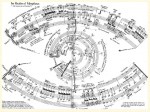
    This example maps properties of the Higgs jet to properties of sound as illustrated in the picture below. A jet is made up of lots of cells containing energy deposits. Each cell has an energy, a distance and an angular distance (dR) associated with it. So each cell can be heard as a separate note in this example. This is quite a long track (about 90 seconds). The sounds reduce in density very much towards the end, with isolated events separated by silences of several seconds.
    diagram


Tags:

Related posts

4

Jun

Sounday Times

Scritto da:Mauro Graziani @ 2010.06.04.02.06.08 — Archiviato in: Audio

Oggi vi presento il Sounday Times.

Non è un errore di stampa. Trattasi di una pubblicazione online dedicata al mondo del sound design e del paesaggio sonoro, per di più in italiano e fatta da italiani.

La trovate qui.


Tags:

Related posts

1

Jun

Tesla Coil Music

Scritto da:Mauro Graziani @ 2010.06.01.00.32.55 — Archiviato in: Audio, Tecnologia

The sound is really produced by the coils. To play an A at 440 Hz the coil generate 440 lightnings per second. The temperature of the lightning is so high that compress the air around generating an audio wave.


Tags:

Related posts

30

May

Space Audio

Scritto da:Mauro Graziani @ 2010.05.30.22.57.03 — Archiviato in: Audio

A good site of “sounds of space” collected by U Iowa instruments on various spacecraft.

Here you can find many sounds “recorded” (remember that this are radio frequencies not audio frequencies) by Cassini, Voyagers and Galileo spacecrafts during the Jupiter and Saturn missions.

The site is Space Audio.

Here you can listen to the famous Cassini’s sound recorded near Saturn claimed to resemble to an alien voice if transposed one octave up preserving the duration:


Tags:

Related posts

23

May

Silophone

Scritto da:Mauro Graziani @ 2010.05.23.17.01.24 — Archiviato in: Architettura, Audio

Silophone combines sound, architecture, and communication technologies to transform a significant landmark in the industrial cityscape of Montreal, Canada.

By telephone, or even the internet, they will send the sound of your choice echoing through the incredible acoustics of abandoned rusted halls and corridors of this imposing building.

Silo #5 is an abandoned grain storage facility in the port of Montréal. A quarter of a mile long and over twenty storeys high, it has a total capacity of five million bushels, or enough wheat to make 230 million loaves of bread. The building was constructed in several stages between 1903 and 1958. The newest part of the building was designed to last for generations, however due to changes in the global grain market and to the general trend of de-industrialization in North America at the end of the 20th century, the building became redundant less than forty years after its completion. Since 1994, Silo #5 has stood empty, and its fate has been hotly debated. The building is situated in one of Montréal’s oldest industrial districts, now rapidly being gentrified and renovated for high-tech commercial, luxury residential, and tourism/leisure industry uses.

The portion of the structure used by Silophone is constructed entirely of reinforced concrete, measures 200 metres long, 16 metres wide and approximately 45 metres at its highest point. The main section of the building is formed of approximately 115 vertical chambers, all 30 metres high and up to 8 metres in diameter. These tall parallel cylinders, whose form evokes the structure of an enormous organ, have exceptional acoustic properties: most notably, a stunning reverberation time of over 20 seconds. Anything played inside the Silo is euphonized, made beautiful, by the acoustics of the structure. All those who have entered have found it an overwhelming and unforgettable experience.

telephone access
Using your telephone, you can enter into — and participate in — the acoustic world of the Silo. More than one person can use the telephone system at once, so when you telephone you may find somebody else already in the Silo. This teleconference system was specifically adapted for use in the Silophone by engineers from Bell’s Emerging Technologies Group.
To call the Silophone from North America: 1.514.844.5555
From the rest of the world: 001.514.844.5555
Wait until the second ring, then start talking.

audio website
Go to the play page of this website to access the on-line dimension of the Silophone musical instrument. From this page, you can send pre-recorded sound files into Silophone by browsing through the thousands of uploaded sounds, or by uploading your own soundfile.

Whenever anyone is playing the Silophone over the telephone, the web, or the sonic observatory, you can hear the results by tuning into our live RealAudio stream. To hear the Silophone stream now, click the “hear Silophone” link at the bottom left hand corner of the page.

silophone 1 silophone
silophone silophone
No tag for this post.

Related posts

19

Apr

Bloop

Scritto da:Mauro Graziani @ 2010.04.19.01.54.44 — Archiviato in: Audio, Scienza

The Bloop is the name given to an ultra-low frequency and extremely powerful underwater sound detected by the U.S. National Oceanic and Atmospheric Administration (NOAA) several times during the summer of 1997. The source of the sound remains unknown.

According to thw NOAA description

it rises rapidly in frequency over about one minute and was of sufficient amplitude to be heard on multiple sensors, at a range of over 5,000 km.

5000 km is a grrreeeat distance for a sound, event in the water that conduct the sounds better than air. While the audio profile of the bloop does resemble that of a living creature, the system identified it as unknown because it was far too loud for that to have been the case: it was several times louder than the loudest known biological sound.

The bloop sound it’s too low to be perceived by a human ear. If transposed up by a factor of 8 (3 octaves), it sounds like this.

No tag for this post.

Related posts

6

Apr

The Power of the Slinkies

Scritto da:Mauro Graziani @ 2010.04.06.19.24.58 — Archiviato in: Audio

SlinkyFor italian people:

Slinky è il nome commerciale di questo giocattolo, formato da una lunga molla elicoidale, in voga (boh) forse 20-30 anni fa (è stato inventato negli anni ‘40; io ne ho almeno 4/5, ma non ricordo quando le ho comprate).

Vedi anche wikipedia.


A sound wave in a long wire travels back and forth and produces an echo effect. This fact was well known to the old sound engineers and the so called spring reverberator was largely used in the analogical era.

In this video micolich shows the power of long springs. When touched, the sound travels repeatedly along the whole length of the spring producing a stream of little echoes with decreasing amplitude. But the sound speed is high, so the time distance between echoes is a question of milliseconds. As result we can’t perceive the single echo, but a decreasing halo that extend the sound: this is the reverberation.

No tag for this post.

Related posts

30

Mar

Electromagnetic sounds from planets

Scritto da:Mauro Graziani @ 2010.03.30.00.01.36 — Archiviato in: Audio, Scienza

Another fascinating recording of space sounds captured by a NASA spacecraft.

This time it’s Jupiter sounds (electromagnetic “voices”) recorded by the Voyager. The complex interactions of charged electromagnetic particles from the solar wind , planetary magnetosphere etc. create vibration “soundscapes”.

Jupiter is mostly composed of hydrogen and helium. The entire planet is made of gas, with no solid surface under the atmosphere. The pressures and temperatures deep in Jupiter are so high that gases form a gradual transition into liquids which are gradually compressed into a metallic “plasma” in which the molecules have been stripped of their outer electrons. The winds of Jupiter are a thousand metres per second relative to the rotating interior. Jupiter’s magnetic field is four thousand times stronger than Earth’s, and is tipped by 11° degrees of axis spin. This causes the magnetic field to wobble, which has a profound effect on trapped electronically charged particles. This plasma of charged particles is accelerated beyond the magnetosphere of Jupiter to speeds of tens of thousands of kilometres per second. It is these magnetic particle vibrations which generate some of the sound you hear on this recording.

It’s interesting to compare this recording with some analog electronic music from the sixties (cfr. Screen (1968) by Jaap Vink) or some orchestral compositions by Gyorgy Ligeti (Lontano (1967) or Atmosphère).

In addition should be interesting to know if and how this recordings had been edited by the people of Brain/Mind Research that sell many NASA recordings.

Here are similar recordings from Uranus…

… and Neptune.


Tags:

Related posts

19

Mar

Animals sound perception: elephants

Scritto da:Mauro Graziani @ 2010.03.19.14.06.46 — Archiviato in: Audio

An interesting table showing the hearing ranges for some animals [from Animal Behavior Online]

domestic cats 100-32000 Hz
domestic dogs 40-46000 Hz
African elephants 16-12000 Hz
bats 1000-150000 Hz
rodents 70-150000 Hz

I am impressed by the incredible hearing range of the rodents.

The infrasonic communications of the elephants is well known. African elephants have a social structure best described as fluid; animals move freely over wide areas, sometimes affiliating with other animals. Female members of a family tend to stay together, and of course their juveniles travel with them. These female-centered groups may merge with other such groups periodically. Adult males are less likely to join groups.

Female African elephants use “contact calls” to communicate with other elephants in their bands (usually a family group). These infrasonic calls, with a frequency of about 21 Hz and a normal duration of 4-5 seconds, carry for long distances (several kilometers), and help elephants to determine the location of other individuals. Calls vary among individual elephants, so that others respond differently to familiar calls than to unfamiliar calls. Perhaps elephants can recognize the identity of the caller.

Perception of infrasounds, however, presents some specific problems. An object smaller than the distance between waves is a poor receiver for those waves. Thus infrasonic receivers need to be large. This is probably the reason that infrasonic communication is used by only a few animals, and the best understood infrasonic communication system is the African elephant’s.

The large pinnae (external portion of the ear; trad.: il padiglione auricolare) in the African elephant may play an important role in the elephant’s perception of low frequency sounds, which are significant in communication among elephants. Receiving structures whose size is matched to the wavelength of the sound perform better.


Tags:

Related posts

« Previous PageNext Page »