4’33”

Ecco il video di una mitica esecuzione di 4'33" per orchestra. Il momento in cui il direttore si deterge il sudore fra il primo e il secondo movimento è puro humour inglese.
Problema: come valutare una esecuzione di 4'33" :-P?

Here is the video of a good execution of Cage’s 4'33", orchestral version. The director wiping off his sweat between 1st and 2nd movement is a moment of great humour.
Problem: how to evaluate a 4'33" execution :-P?

I have nothing to say
and I am saying it
and that is poetry
as I needed it
— John Cage


http://youtu.be/zY7UK-6aaNA

In memoriam György Ligeti

Come è giusto i tributi sono molti. YouTube rilancia il video originariamente trasmesso da arté (la TV culturale che si vede ovunque in Europa tranne che in Italia) con l’esecuzione del Poema Sinfonico per 100 Metronomi.

There are many “in memoriam” tributes on the web. On YouTube you can see the arté video of the Poème Symphonique pour 100 Metronomes.

Composers and geographers

Alexander Island

Seems to be a place where geographers finally remember composers. In the Alexander Island (71°00′S 70°00′W, part of Antarctica) you can find the Shostakovich, Beethoven and Monteverdi Peninsulas, the Mendelssohn Inlet, the Brahms Inlet and the Verdi Inlet. The Bach Ice Shelf, Rossini Point and Berlioz Point are a bit away.
Many other sites in this island have composers names.
Click here to see a bigger map

György Ligeti is dead

I don’t like to carry bad news. Two days ago the composer György Ligeti (age 83) is dead in Vienna.
IMHO his most important and innovatives works are the compositions of sixties, starting with Apparitions (1959) to the Double Concerto for Oboe and Flauto 1972), through works like the Requiem, the Cello Concert, Lux Aeterna, Lontano, Ramifications, the Chamber Concerto, Melodien.
In this works Ligeti completely abandons the traditional melody, harmony and rhythm to create a musical flow made by clusters, chords and sound masses that seem to be still but live by an inner micropolyphony. A sound texture on which rhythm, harmony and micro melodies are melted to create an ever changing timbre, using traditional instruments to create sounds that resembles electronic textures.
Other Ligeti’s works are important in the music history, but the emotions that I feel when I first listened this music in the ’70 (I was about 20) are the things that I really like to remember.

György Ligeti on Wikipedia

New Musical Instruments: Audiopad

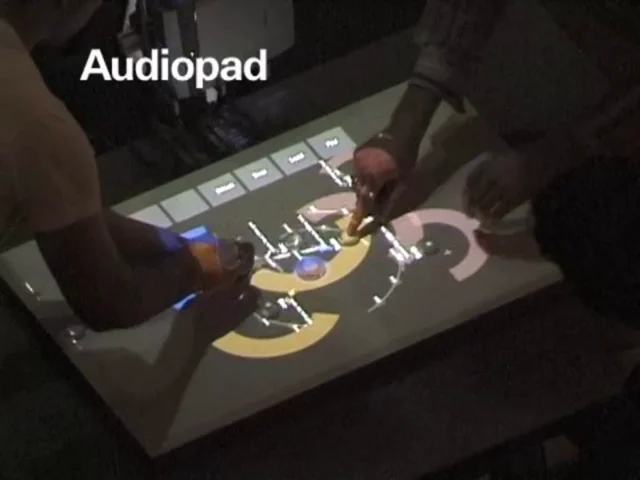
Audiopad has been developed by two MIT graduate students (James Patten and Ben Recht). It is one of the most interesting and futuristic musical controller ever seen in action.
Audiopad itself has its sound sample library and can play music and apply digital processing at the same time but can also control a real time synthesis software like MAX/MSP running on external computer or even a set of MIDI synthesizers.
Basically Audiopad is composed by a tabletop surface (a sort of big horizontal screen) on which different symbols and musical data are displayed. On the tabletop there are objects the performer can move. Audiopad generate music looking at the motion of that objects and their position with respect to the displayed symbols.
Depending on the software, the symbols type and their meaning can be different and so is the interaction with objects. Example: symbols can represent instruments and an object can be a melody. Moving the object on a symbol means that the performer assign that melody to that instrument. Another object can be a microphone, so moving the microphone near/far a melody or instrument raise/lower it’s volume.
Moreover the tabletop display is not static but can change when the performer moves the object on certain symbols opening new ways to the performer action.
Audiopad is very different from traditional computer interaction (the desk, monitor, keyboard and mouse model). The best way to understand it’s nature is seeing in action.
Unfortunately Audiopad is not currently for sale. The only musical interface that moves in that direction is Lemur (we’ll speak about later), but it’s only a programming touch-screen, a single step with respect to Audiopad complexity.

Little Robot Dogs

Searching for robot dogs after the Aibo’s end of production I found some nice toys.
The first is called iDog by Sega Toys (the name don’t sound new, reminds something…). It seems more an MP3 gadget than a real dog. According to the video I saw (see link at the end of post), it moves only head, ears and tail, but it follows the music with blinkin leds on the head.
This little robot react to music. More, it has a speaker inside and a little 3.5mm jack connection so you can plug it into a MP3 or CD players and of course the iPod. If you turn the music off the iDog complais and barks (could be a little annoying). About $50.
More interesting is the i-Cybie (by Silverlit from Honk-Kong) that is a real robot pet similar to Aibo (less powerful but cheaper: official price is $199, can buy for less).
It can respond to sound, touch, voice commands and its own remote control but don’t let that fool you i-Cybie has a fun repertoire of tricks it can perform, including telling you when his batteries are running low & also has a walk up charger to power itself .
i-Cybie moves and has many sensor:

  • Motion sensors allow i-Cybie to detect movement around him. These are used when you place him in Guard mode.
  • Obstacle sensors are used to navigate your home and avoid bumping into things.
  • With the touch sensor on his back you can pet him and he’ll react to your touch.
  • Sound sensors let i-Cybie respond to your voice commands or to clap commands.
  • Tilt sensors let him know when he has fallen down.
  • Light sensors let him detect changes in ambient light in your room.

Last, i-Cybie can interact with other i-Cybie’s using it’s built-in IR communicator, as long as the other dog is within 3 feet of him. I ask what kind of info they can exchange. My conspiracy oriented mind can imagine many interesting situations.

Ok. I’m searching for other pet robots. Stay tuned.

Links:
iDog (eDog in Europe).
i-Cybie.

学习汉语

According to Google translator, these signs mean “learning the Chinese”. I advise you to begin. You can find booklets for a few dollars. In these last days I have been shocked by 2 numbers:

  1. Today a chines blog hold the 1st place in the Technorati rank that list millions of blogs sorted by links number (you can find it here). Note that this blog is written in chinese only, it’s not a bilingual one. It means that the chinese webspace alone can generate more traffic that the rest of the world.
  2. In the rank of cellular phone selling, China comes 1st with a little more of 400 millions of items, USA hold the 2nd place with 200 millions. Here in Italy we have 70 millions of cellular phones, that is 1.4 for each person, counting newborn babies. If the Chinese were rich as we are and developed in the same way (including our cellular mania), the chinese market could buy 1 billion 680 millions of items.

06/06/06

Ieri, martedì, era il giorno del numero della bestia: 06/06/06. Me ne sono accorto scrivendo la data di una lezione e ho pensato che, per trovare un surrogato, bisogna arrivare almeno al 2106.
Comunque non è successo niente.
Apparentemente…

Yesterday, tuesday, was the date of the Beast: 06/06/06. I found it while writing the date of a lesson in school.
However nothing happened.
Apparently…

Long live Aibo (1999 – 2006)

Following the Sony Corporation FY05 3Q announcement, the production of AIBO Entertainment Robots will be discontinued as of end March 2006.

You can say it’s stupid and absurdly expensive (last price was $1599) but has been the first serious attempt to build a real robot pet for the rest of us. Aibo, the Sony robot dog, dies in 2006 leaving thousands specimen moving around searching for spare parts and software upgrades without the hope to see a new generation.
You can say I’m strange, but I’m sad. After all, Aibo idea comes from the Golem’s dream, a dream that is part of the human race from ever and ever: creating life from lifeless, becoming God.
Someone say Aibo means nothing simply because a real dog can make the work much better, but imho it’s not true. We can’t live without impossible dreams and when a dream dies we all lose something.
Aibo is not a dog and don’t want to mimic a dog. It’s an hybrid, a new species that moves a little like a dog, but can say some word and sometimes sing. And I can love it like a real dog.
Moreover with Aibo you can say strange things like “Enough! Turn off the dog and go sleep!” or “Wake up, go walking, turn on the dog”.

Long live, Aibo…

I dadi di Mozart

A quanto pare quest’anno è difficile non parlare di Mozart. Qui però ci occupiamo di un aspetto dell’attività di Wolfang forse un po’ più ludico, ma sempre molto interessante.
Nel 1793, due anni dopo la sua morte, venne pubblicato, con grande successo, un Musikalisches Würfelspiel (gioco musicale con i dadi) che permetteva di comporre un minuetto senza alcuna conoscenza musicale, utilizzando due dadi e una serie di battute predefinite. Si tratta di un esempio di composizione algoritmica ante litteram anche se val la pena di ricordare che la seconda metà del XVIII° secolo vide una certa fioritura di giochi musicali di questo tipo.

La paternità Mozartiana di quest’opera è stata a lungo discussa, ma ormai sembra assodata.
Le regole da osservare sono molto semplici. Un minuetto, all’epoca, aveva una forma pressoché standardizzata, in 3/4, composta da una prima parte (il minuetto), seguita da una parte centrale, di andamento più melodico e disteso, detta “trio” perché in origine era affidata a tre strumenti e si chiudeva con la ripresa del minuetto di partenza.
Sia il minuetto che il trio erano di 16 battute e nel creare la loro struttura interna era possibile utilizzare uno schema preciso. Il minuetto della Kleine Nachtmusik, per esempio, è composto da una frase di 4 battute (A) a cui segue una variazione di eguale durata (A’); abbiamo poi una seconda frase (B), sempre di 4 battute, che si conclude con una ripresa di A’. A sua volta, il trio si apre con una melodia (C) di 8 battute seguita da un motivo diverso (D), lungo 4 battute, che sfocia, in chiusura, in una ripresa abbreviata di C.
Erano strutture di questo tipo a permettere l’automazione compositiva realizzata da Mozart. Il gioco si basa su due tabelle, una per il minuetto, per il quale si utilizzano 2 dadi, e l’altra per il trio, per il quale è sufficiente un solo dado e da un libretto in cui si trova un elenco di 176 battute composte da Mozart. Ogni tabella ha in ascissa il numero di battuta e in ordinata il risultato del lancio dei dadi. All’intersezione di ascissa e ordinata si trova il numero della battuta da utilizzare.
L’utente deve semplicemente lanciare i dadi una volta per ogni battuta e trascrivere la battuta corrispondente copiandola dall’elenco e ponendola dopo la precedente.
Lanciando 16 volte i dadi, quindi, si ottengono le 16 battute che formano il minuetto. La tabella per il minuetto, infatti, ha 11 righe (i dadi vanno da 2 a 12) per 16 colonne e in questo caso, Mozart ha scritto 11 battute possibili per ognuna delle 16 battute del minuetto (11 * 16 = 176).
Per “comporre” il trio, invece, si utilizza un solo dado e la tabella ha solo 6 righe. Per ogni battuta, quindi, Mozart ha scritto 6 possibili battute.
L’abilità di Mozart, in questo caso, è stata quella di scrivere delle battute che potessero in ogni caso concatenarsi logicamente senza creare grandi scompensi con ognuna delle precedenti. Trattandosi di musica tonale, la cosa è meno complessa di quanto può sembrare a prima vista (la tonalità è sempre la stessa, Re per il minuetto, Sol per il trio), ma resta sempre piuttosto difficile se si considera anche il fatto che una composizione di questo tipo non ammette grandi irregolarità sequenziali.
Infine, sarebbe interessante sapere se Mozart, nel disporre le battute nelle tabelle, ha tenuto conto delle diverse probabilità di uscita determinate dal lancio dei dadi. Il problema non si pone nel caso del trio in cui si usa un solo dado e ogni numero ha probabilità 1/6, quanto per il minuetto per il quale si utilizzano 2 dadi con probabilità differenti per gli 11 possibili risultati. Con 2 dadi, infatti, il 7 ha le probabilità maggiori perché si ottiene con 6 combinazioni diverse. Seguono il 6 e l’8 con 5, il 5 e il 9 con 4, il 4 e il 10 con 3, il 3 e l’11 con 2, mentre il 2 e il 12 si ottengono con una soltanto.
In definitiva, comunque, con questo sistema possono essere generati 1116 cioè 45.949.729.863.572.161 minuetti e 616 cioè 2.821.109.907.456 trii. Dato che il minuetto come forma musicale è composto da un minuetto e un trio, abbiamo un totale di 129.629.238.163.050.258.624.287.932.416 diverse composizioni possibili. Ovviamente molte di loro saranno quasi uguali in quanto la differenza sarà costituita soltanto da una o due battute; ciò nonostante, su un totale così elevato, restano da ascoltare ancora molte interessanti combinazioni.
Il problema è che, anche tralasciando la ripresa finale del minuetto, ogni brano dura circa un minuto, e quindi servirebbero 246.630.970.629.852.090.228.858 anni per ascoltarli tutti.

Cliccando qui potete ascoltare uno di questi minuetti, mentre qui trovate un sito che implementa il gioco.