
It’s not that I’m so smart; it’s that I stay with the problem longer.
[Albert Einstein]
Monthly Archives: February 2010
PALAOA
The hydrophones of German Alfred-Wegener-Institut transmitting live from the Ocean below the Antarctic Ice in the Atka Bay. This project is called PALAOA (PerenniAL Acoustic Observatory in the Antarctic Ocean) that means “whale” in Hawaiian.
Click here for mp3 audio stream.
Please note, this transmission is not optimized for easy listening, but for scientific research. It is highly compressed (24kBit Ogg-Vorbis), so sound quality is far from perfect. Additionally, animal voices may be very faint. Amplifier settings are a compromise between picking up distant animals and not overdriving the system by nearby calving icebergs. So you might need to pump up the volume – but beware of sudden extreamely loud events.
There is also a webcam showing images like this one (click to enlarge)

Xenakis drawings
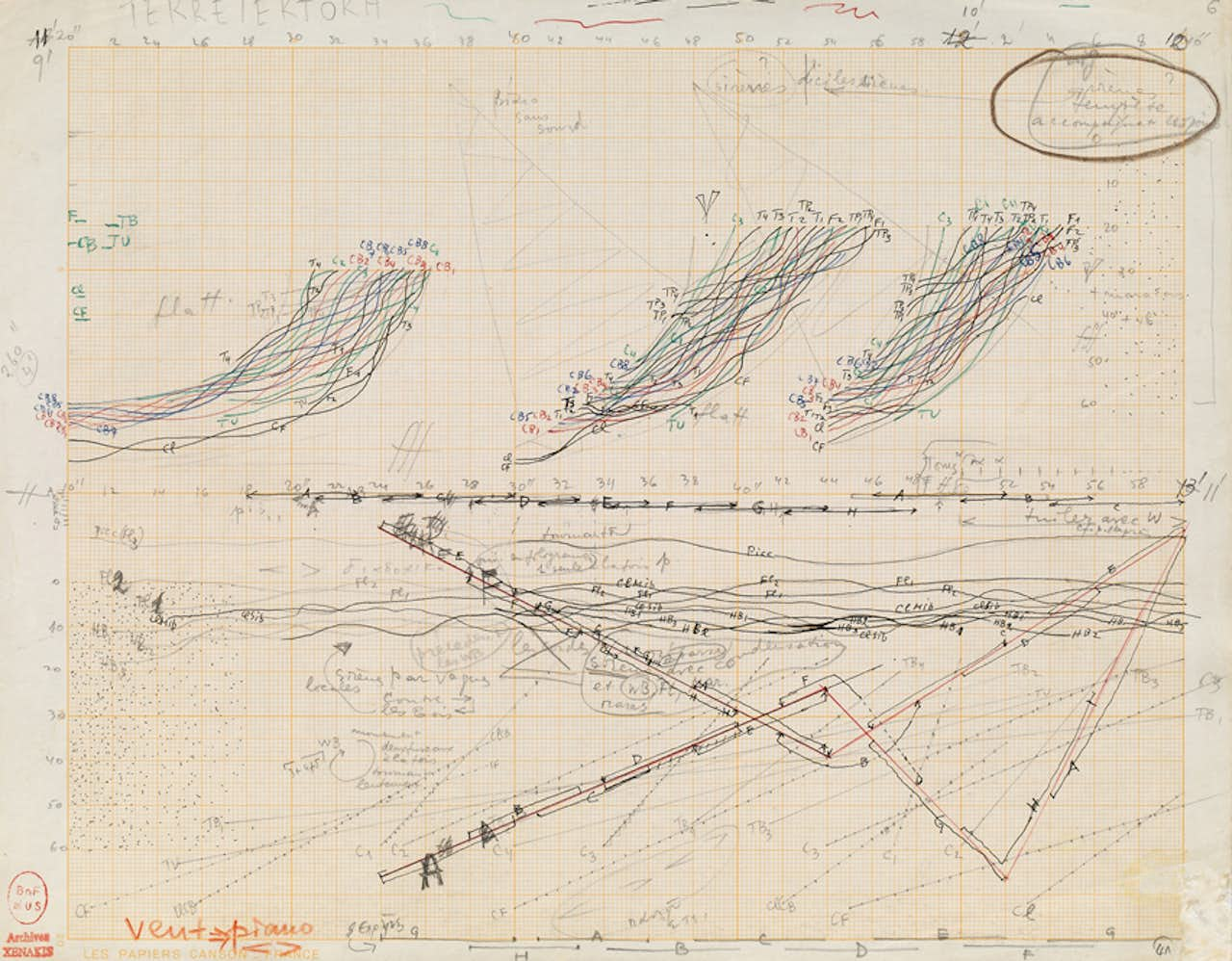 The Drawing Center (35 Wooster Street, New York) opens a large show (nearly 100 works) of drawings by Iannis Xenakis (1922-2001), including mathematical renderings, architectural plans and sketches for compositions.
I know that it’s a little away from here, but see this page for drawing examples with video and audio.
Dynamic Books
Macmillan announced a new kind of textbook called DynamicBooks: a remixable electronic textbook that will give professors the ability “to reorganize or delete chapters; upload course syllabuses, notes, videos, pictures and graphs; and perhaps most notably, rewrite or delete individual paragraphs, equations or illustrations.” Essentially, Macmillan provides the core text, and then professors get to customize the book to their liking.
According to Macmillan, this will cut the price of new textbooks.
From Open Culture
Wet Ink
The Wet Ink Ensemble is a New York-based new music collective. Our mission is to present innovative programs of contemporary music, with a focus on creating, promoting, and organizing adventurous American music.
Pendulum V – Alex Mincek – Wet Ink Ensemble from Wet Ink Ensemble on Vimeo.
Gelie
An interesting application for iPhone that links sound and gestures. The sound needs some improvements but the idea is stimulating.
Ringu, la saga continua…
A mio modesto avviso, qui qualcun’altro deve morire se proprio non riesce ad astenersi…
Vogliamo ricominciare a prendere le cose un po’ seriamente, di qualsiasi cosa si tratti?
“Sì, lo so che non so cantare, ma vado a sanremo”.
“Sì, lo so che non so amministrare, ma faccio il politico”.
Ma il termine “etica” dice qualcosa a ‘sta gente? Diamoci tutti una rinfrescata qui su wikipedia (bastano le prime righe)
E poi rivitalizziamo il vecchio slogan da stadio “de-vi mo-riii-re!”. Non sarà corretto, ma…
Chi ha scritto Scelsi?
Fortunatamente sono sfuggito al festival nazional-popolare, ma ho passato la serata di sabato prima dormicchiando e poi riflettendo sulla vicenda di Giacinto Scelsi e del suo principale trascrittore, Vieri Tosatti. Riflessioni stimolate da una bella conferenza di Franco Sciannameo a cui ho assistito, nel pomeriggio, al Conservatorio di Trento, dove insegno.
La vicenda è ben nota agli addetti ai lavori (o almeno dovrebbe esserlo), ma vale la pena di riassumerla. In breve, Giacinto Scelsi (1905 – 1988), ormai riconosciuto come uno dei più importanti compositori contemporanei e anticipatore sia della minimal music che dello spettralismo (con i famosi Quattro pezzi per orchestra su una nota sola del 1959), in realtà non ha mai scritto materialmente una nota. Il suo lavoro, invece, consisteva nel registrare su nastro l’essenza delle proprie idee musicali eseguendole (spesso improvvisando) sull’ondiola (nome originale ondioline), una tastiera elettronica inventata dal francese Jenny, in grado di produrre anche quarti e ottavi di tono.
I nastri venivano poi passati a dei trascrittori che, in concerto con il compositore, trascrivevano il materiale su pentagramma, curando anche l’orchestrazione. Il principale fra costoro fu Vieri Tosatti (1920 – 1999) che, in verità, dopo la morte di Scelsi, creò anche una polemica con la dichiarazione “Scelsi c’est moi”, ma il cui contributo passò rapidamente in secondo piano.
E invece, secondo gli studi e i ricordi di Sciannameo, che fu violinista nel quartetto che curò la prima esecuzione dei brani orchestrati da Tosatti per questo organico, dovrebbe essere rivalutato perché il suo sodalizio trentennale con Scelsi lo pone in una posizione che va sicuramente al di là di quella del semplice trascrittore, al punto che molti critici che osannano la genialità sonora di Scelsi, dovrebbero invece ricordare che il “rendering audio” dei lavori di Scelsi è in gran parte opera di Tosatti, essendo quest’ultimo “l’arrangiatore” che ha materialmente orchestrato il materiale di base.
In realtà, anche secondo me, è giusto affermare che i nastri originali andrebbero stampati e diffusi (mi dicono sia in corso un lavoro di catalogazione e “pulitura” del suddetto materiale da parte della Fondazione Scelsi) perché sono proprio questi ad essere storicamente testimoni dell’idea originale di Scelsi, mentre la musica stampata dovrebbe essere considerata come una “trascrizione approvata dal compositore”.
Ma mi chiedo anche se sia proprio così. Il problema è: in che misura i nastri sono depositari dell’idea compositiva? Rappresentano la composizione in quanto unica testimonianza originale, oppure sono soltanto un ulteriore elemento di passaggio verso la formalizzazione di una idea musicale?
Sciannameo ha portato alla luce una corrispondenza risalente agli anni ’30 fra Scelsi e Walter Kline (descritto spesso come allievo di Schoenberg, ma, secondo Sciannameo, amico di Schoenberg, forse allievo di Berg) che testimonia come l’impostazione compositiva di Scelsi sia stata da sempre un po’ particolare, basata com’era sulla produzione di una idea musicale, lasciando a dei collaboratori il compito di orchestrare e a volte anche di sviluppare il concetto originario.
Questo metodo di lavoro, forse derivante anche dalla condizione aristocratica di Giacinto Scelsi, a mio avviso non ne sminuisce la genialità, ma induce a riflettere sulla genesi e sulla effettiva paternità dell’opera d’arte che, nella tradizione occidentale, è considerata un prodotto del tutto individuale, mentre spesso (e attualmente sempre di più) si rivela essere il prodotto dell’interazione di più di una mente.
Personalmente, devo aggiungere che, alla fine, quello che mi dispiace un po’ in questa vicenda è proprio il fatto che, a causa di un pregiudizio legato alla tradizione individualistica della composizione, il sodalizio Scelsi – Tosatti sia stato tenuto nascosto per molto tempo e sia ancora fonte di studi e polemiche, mentre, secondo me, sarebbe stato vissuto molto meglio dai protagonisti (soprattutto da Tosatti) se fosse stato trasparente e socialmente accettato come una collaborazione perfettamente normale fra due persone, ognuno con il proprio ruolo.
Pirating vs buying
This funny chart (found on Boing Boing) does a superb job of explaining how the insertion of a lot of “business model” (FBI warnings, unskippable trailers, THX vanity sequences) makes buying a DVD a lot worse than pirating the same disc online (click image to enlarge).
A side effect is that only the legitimate customers can see the FBI warnings.

The same (or worse) happens with the games. I bough a PC game to play on the train (I move 2/3 days a week) and I must carry the original CD-Rom with me to start the game, at high risk.
Of course the pirated copy starts without any CD. The customer pay to buy the game and must suffer all the annoyances. A pirate don’t pay and has no problems. It’s a no win situation…
Australian spaces
The wide landscapes of Australia are the new spaces of contemporary sculpture

Neil Dawson’s Horizons, made of welded steel, is an imposing 15m high and 36m long.

Anish Kapoor’s Untitled is 25m long, 8m high and made of mild steel tube and tensioned fabric.

Andy Goldsworthy’s Arches was created in 2005. It is partly submerged at high tide. It consists of 11 5m-high sandstone arches.

George Rickey’s Column of Four Squares Gyratory III is 15m high.

Richard Serra’s 257m-long, 6m-high Te Tuhirangi looks delicate from above, but up close become as imposing as the wall of a full dam.
From The Australian
Playing the building
Playing the Building is a sonic project by ex-Talking Head David Byrne that came to London in 2009. You could sit down at an “antique organ” and hit whatever keys or chords your heart desired—but you wouldn’t be producing notes.
You would instead trigger a “series of devices,” as Byrne describes them: hammers and dampers distributed throughout the building in which you sat. Distant windowpanes and metal cross-beams, hooked up to wires, would begin to vibrate, tap, and gong. Imagine someone like this sitting in the darkness beneath Manhattan, causing haunted musics and unexplained knocks inside rooms and abandoned buildings around the city. Now, even urban infrastructure will be musicalized.
The Ocean of Light
The Ocean of Light project explores the creative and immersive possibilities of light-based visualisation in physical space. It uses bespoke hardware to create dynamic, interactive and three-dimensional sculptures from light.
Surface is the first artwork to be exhibited using the Ocean of Light hardware. It uses minimal visuals and sound to evoke the essence of character and movement. Autonomous entities engage in a playful dance, negotiating the material properties of a fluid surface.
The Ocean of Light project is a collaborative research venture, led by Squidsoup and supported by the Technology Strategy Board (UK). Partners include Excled Ltd and De Montfort University. Additional support and resources have been provided by Oslo School of Architecture and Design (Norway), Massey University, Wellington (New Zealand) and Centre for Electronic Media Art, Monash University (Aus).
Squidsoup is a digital arts group specialising in immersive interactive installations within physical 3D space. Their work combines sound, light, physical space and virtual worlds to produce immersive and emotive headspaces. They explore the modes and effects of interactivity, looking to make digital experiences where meaningful and creative interaction can occur.
Hitler about iPad
Hitler’s opinion about iPad.
Mixtur 2003
Karlheinz Stockhausen, “Mixtur 2003 (Forward Version)”
for 5 orchestra groups, 4 sine-wave generator players, 4 sound mixers, with 4 ring modulators and sound projectionist
From the Musica Viva Festival
Bavarian Radio Orchestra, Lucas Vis
Recorded January 27, 2008
Muffathalle, Munich
The essential aspect of MIXTUR is, on one hand, the transformation of the familiar orchestra sound into a new, enchanting world of sound. It is an unbelievable experience, for example, to see and hear string players bowing a sustained tone and to simultaneously perceive how this tone slowly moves away from itself in a glissando, the pulse accelerates, and a wonderful timbre spectrum emerges. Orchestra musicians are astonished when they hear the notes they play being modulated timbrally, melodically, rhythmically, and dynamically. All shades of the transitions from tone to noise, noise to chord, from timbre to rhythm and rhythm to pitch come into being from such ring modulations, as if by themselves.
Finest micro-intervals, extreme glissandi and register changes, percussive attacks resulting from normally smooth entrances, complex harmonies (also above single instrumental tones), and many other unheard-of sound events result from this modulation technique and from the variable structuring.
Secondly, the ring modulation adds new overtone- and sub-tone series to the instrumental spectra, which can be clearly heard, especially during sustained sounds in MIXTUR. Such mixtures do not occur in nature or with traditional instruments. Through these mirrored overtone harmonies, one is moved by alien, haunting sensations of beauty, which are completely new in art music.
Only such renewal in how music affects us imbues new techniques with meaning.
— Karlheinz Stockhausen
From ANABlog
iMussolini
 Che cosa sia l’Italia oggi si può anche dedurre anche dal fatto che una applicazione su iPhone che contiene clips audio, video e testi di 100 discorsi del dittatore è stata la più scaricata nel nostro paese nel breve tempo in cui era disponibile, raggiungendo il 2° posto nella classifica del software iPhone in Italia.
L’applicazione è stata rimossa grazie all’intervento dell’istituto che possiede i diritti sul video e l’audio. La minaccia di una causa per violazione di copyright è servita ad indurre il suo creatore, tale Luigi Marino, 25 anni, di Napoli, a ritirarla.
Se ne parla anche sulla stampa estera (NY Times, BBC News), oltre che su quella locale (Corriere).
Imaginary Landscapes
Speaking about Brian Eno (see previous post), on You Tube there is the whole Imaginary Landscapes, a film on Eno by Duncan Ward & Gabriella Cardazzo.
Imaginary Landscapes is a profile of a modern artist at the cutting edge of technological change and popular taste. It brings into an intensely personal focus Brain Eno’s seemingly disparate work in sound, vision and light, and explores his music in visual terms, based on landscapes and images that have shaped his life as an artist.
An audience with Brian Eno
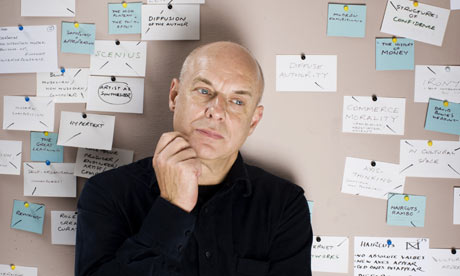 Paul Morley recently spoke to Brian Eno for a BBC arena documentary in which Eno proved that he is always good for a controversial and catchy phrase about the music industry:
The record age was just a blip. It was a bit like if you had a source of whale blubber in the 1840s and it could be used as fuel. Before gas came along, if you traded in whale blubber, you were the richest man on Earth. Then gas came along and you’d be stuck with your whale blubber. Sorry mate – history’s moving along. Recorded music equals whale blubber. Eventually, something else will replace it.
The whole interview is published on the Guardian’s site.
Berlusconi on Photoshop Disasters
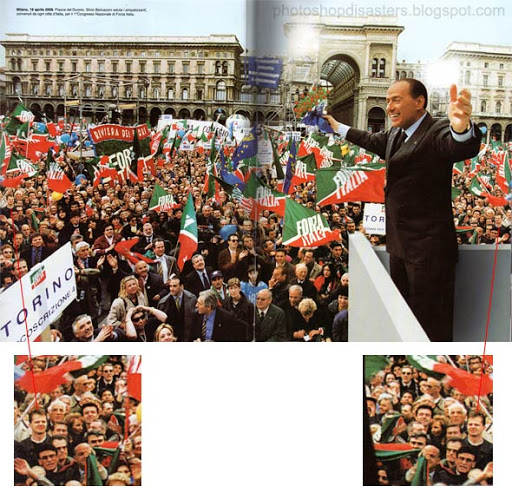
Il nostro elegante commander-in-chief è finito sul popolare Photoshop Disasters per una serie di immagini malamente e dilettantisticamente ritoccate tratte dal libro Noi amiamo Silvio edito da Peruzzo.
Nella fattispecie si vede una foto in cui pezzi di folla sono stati chiaramente duplicati al fine di far apparire più gente intenta ad osannare il nostro. Anche il mazzo di fiori è disegnato gran male. In realtà è probabile che questa immagine sia il montaggio di tre foto: Berlusconi, la folla, piazza Duomo. Il fatto che la menzogna sia utilizzata come normale strumento di propaganda dovrebbe far pensare.
Il commento di Photoshop Disasters:
Oh Silvio. I have no problem with your mafia connections, your masonic lodge business, the tax fraud, the false accounting, the bribing of judges, embezzlement, seducing young girls, etc. We all do that kind of thing. But when you start pumping up your crowds with Photoshop you cross the line, mister.
In Holden’s footsteps
 Chi ha letto Il giovane Holden (The Catcher in the Rye, J.D. Salinger, 1951) potrà ora seguire le sue deambulazioni per Manhattan grazie a una mappa interattiva completa di citazioni pubblicata sul New York Times.
Trace Holden Caulfield’s perambulations around Manhattan in “The Catcher in the Rye” to places like the Edmont Hotel, where Holden had an awkward encounter with Sunny the hooker; the lake in Central Park, where he wondered about the ducks in winter; and the clock at the Biltmore, where he waited for his date. Roll your mouse over each point and read about Holden’s experience there in J.D. Salinger’s words.
Hubble look at Pluto
 Since its discovery in 1930, Pluto has been a speck of light in the largest ground-based telescopes. But NASA’s Hubble Space Telescope has now mapped the dwarf planet in never-before-seen detail. The new map is so good, astronomers have even been able to detect changes on the dwarf planet’s surface by comparing Hubble images taken in 1994 with the newer images taken in 2002-2003. The task is as challenging as trying to see the markings on a soccer ball 40 miles away.
Hubble’s view isn’t sharp enough to see craters or mountains, if they exist on the surface, but Hubble reveals a complex-looking and variegated world with white, dark-orange, and charcoal-black terrain. The overall color is believed to be a result of ultraviolet radiation from the distant Sun breaking up methane that is present on Pluto’s surface, leaving behind a dark, molasses-colored, carbon-rich residue. Astronomers were very surprised to see that Pluto’s brightness has changed — the northern pole is brighter and the southern hemisphere is darker and redder. Summer is approaching Pluto’s north pole, and this may cause surface ices to melt and refreeze in the colder shadowed portion of the planet. The Hubble pictures underscore that Pluto is not simply a ball of ice and rock but a dynamic world that undergoes dramatic atmospheric changes.
Click the image to enlarge. Original site is here.
Torment of the Metals
 The sound of Akashic Crow’s Nest begins with the use of an image synthesizer which turns very long photographic images into audio output, in the manner of a piano roll. The initial part of composing this music is thus designing the picture. For this latest project, the first audio output is converted to midi and run through a different softsynth, before being subjected to a battery of effects to get to the sounds you hear on this album.
Download from Webbed Hand Records
Excerpt:
Interlace
The English netlabel INTERLACE devotes to concerts featuring free improvisation, live electronic music, interactive composition, and, of course, a mixture of it all. It is a continuous series of concerts aiming at 3 or 4 times per year.
Excerpts from the Interlace archives: three improvisations from the concert dated 18 July 2009