Musica Arte Tecnologia Storie Estreme

23

Aug

Il mondo senza di noi

Scritto da:Mauro @ 2008.08.23.00.01.21 — Archiviato in: Letteratura

Vedo che non sono l’unico ad avere di queste curiosità.

È uscito in paperback il libro “The World without us” del divulgatore scientifico Alan Weisman. Le sue profezie sono decisamente pessimistiche:

With no one left to run the pumps, New York’s subway tunnels would fill with water in two days. Within 20 years, Lexington Avenue would be a river. Fire- and wind-ravaged skyscrapers would eventually fall like giant trees. Within weeks of our disappearance, the world’s 441 nuclear plants would melt down into radioactive blobs, while our petrochemical plants, ‘ticking time bombs’ even on a normal day, would become flaming geysers spewing toxins for decades to come… After about 100,000 years, carbon dioxide would return to prehuman levels. Domesticated species from cattle to carrots would revert back to their wild ancestors. And on every dehabitated continent, forests and grasslands would reclaim our farms and parking lots as animals began a slow parade back to Eden.

Tags:

Related posts

6

Jul

Suona un po’ questa…

Scritto da:Mauro @ 2008.07.06.17.40.30 — Archiviato in: Contemporanea, Umorismo

Some weird scores. Click the image to enlarge.

The three scores below are by John Stump, composer of several joke musical scores which are impossible to play, wildly complex and contain bizarre stage warnings such as “shock therapy may be necessary to finish”.

The fourth is by the japanese composer Yamasaki Atushi. I have no info about him.

Tags: ,

Related posts

4

Jun

Le truppe dell’impero

Scritto da:Mauro @ 2008.06.04.00.01.31 — Archiviato in: Fotografia

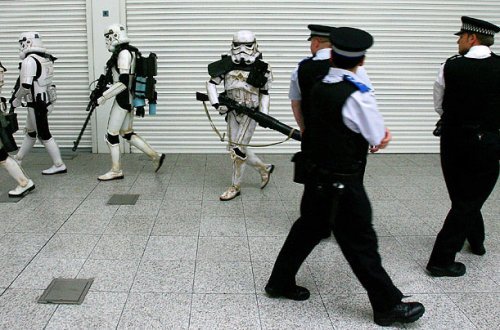
Stormtroopers e cops londinesi si guardano male in una strada di Londra.

Via kiku’s on tumblr.

Tags:

Related posts

30

Jan

Il triangolo delle Bermude delle auto

Scritto da:Mauro @ 2008.01.30.00.01.00 — Archiviato in: Varie

Secondo il Daily News, le auto si guastano misteriosamente se vengono parcheggiate in un raggio di 5 isolati dall’Empire State Building a NY. In figura l’area incriminata.

Le luci funzionano, il clacson va, ma l’auto non parte. L’opinione popolare addossa la colpa alla miriade di antenne piazzate su quello che è tornato ad essere il grattacielo più alto della città.

Dopo il 9/11, infatti, i trasmettitori radio-TV sono tornati in forze sull’Empire che ormai ospita 13 antenne TV e 19 ripetitori FM.

Via Boing Boing

Tags:

Related posts

21

Jan

Popolazione zero

Scritto da:Mauro @ 2008.01.21.02.55.30 — Archiviato in: Società

Una delle domande che, per una ragione o per l’altra, ogni tanto mi capita di pormi è la seguente:

  • quanto durerebbe la nostra cosiddetta civiltà senza di noi? Se la razza umana semplicemente sparisse in un solo istante, ma senza distruzioni, cataclismi o guerre, una semplice sparizione improvvisa, per quanto durerebbero le nostre infrastrutture senza alcun intervento umano? Per quanto tempo, per esempio, ci sarebbero l’acqua, il gas, la corrente, internet?

E voi mi dite, a qual pro? Nessuno, ovviamente. Si tratta solo di una congettura che però mette in luce il fatto che noi, come singole persone, non sappiamo quasi nulla sulle infrastrutture che ci mantengono in vita.

Prendiamo, per esempio, la corrente elettrica. Da cosa dipende la fornitura di elettricità che arriva a casa vostra? Se dipendesse da una fonte rinnovabile (tipo centrale idroelettrica), forse potrebbe anche continuare per anni. E se invece dipendesse dal petrolio o dal carbone, quanto durerebbero le scorte? E in ogni caso, la fornitura continuerebbe anche se non ci fosse un umano che, in certe occasioni, preme un determinato bottone?

Ovviamente qualcuno che può rispondermi c’è, probabilmente anche fra di voi. Magari c’è qualcuno che lavora all’ENEL o alla Telecom o anche al comune e sa queste cose.

Era un po’ che non ci pensavo, ma la faccenda mi è tornata in mente per due ragioni: la prima è che ho visto “Io sono leggenda”, film a mio avviso abbastanza deludente, tanto che, mentre lo guardavo, mi sono trovato a chiedermi se il fatto che nell’appartamento del protagonista ci fossero tutte le comodità, anche dopo anni, fosse realistico.
La seconda ragione è che, vagando nella rete, ho incocciato “Life After People“, una serie prodotta da History Channel la cui programmazione inizia proprio stasera negli USA.

Probabilmente, la domanda più corretta è: con quali modalità queste reti degradano? Un pezzettino alla volta o un crollo totale? E in quanto tempo?

Allora, c’è nessuno in grado di soddisfare la mia curiosità?

Tags:

Related posts

23

Dec

師走 : gli insegnanti corrono

Scritto da:Mauro @ 2007.12.23.00.01.48 — Archiviato in: Giappone, Società, Umorismo

Dato che, a quanto ne so, parecchi fra voi sono insegnanti di vario ordine e grado, vi farà piacere sapere quanto segue.

Rispolverando un po’ del mio malandato giapponese, mi torna in mente che, in Giappone, il mese di Dicembre viene chiamato anche shiwasu (師走) che letteralmente significa “teachers running” (insegnanti che corrono). Il primo dei due ideogrammi, infatti, è “shi”: insegnante, maestro, mentre il secondo è la radice del verbo hashiru che significa correre, muoversi rapidamente.

Tutto ciò a riflettere il fatto che Dicembre è un mese così “busy” che perfino gli insegnanti, che normalmente ciondolano qui e là senza avere molto da fare, sono in estrema agitazione perché ci sono un sacco di carte da presentare e cose da chiudere.

A peggiorare la considerazione di noi insegnanti c’è anche il fatto che una mia amica giapponese mi ha tradotto shiwasu con “teachers run around” che a prima vista sembra uno dei tanti phrasal verb tipo run about, ma invece c’è una bella differenza. Secondo il Merriam-Webster, infatti, run around significa “mettere in atto una azione evasiva e/o ritardante in risposta a una richiesta precisa”.

Andiamo bene… 8O

Tags:

Related posts

28

Feb

Nostalgia

Scritto da:Mauro @ 2007.02.28.00.01.54 — Archiviato in: Scienza, Storia

Contrary to our intuition, nostalgia comes to us from medicine, not from poetry or politics. The word - and amalgam of the Greek word nostos (“return home”) and the New Latin algia (“longing”) - first appeared in 1688 in the medical dissertation of Johannes Hofer, a Swiss student who coined the term to describe “the sad mood originating from the desire to return to one’s native land.” (Hofer also suggested nosomania and philopatridomania to describe the symptoms.) Among the first victims of the newly diagnosed disease were various displaced people from the seventeenth century — freedom-loving students from the Republic of Berne studying in Basel, domestic help and servants working in France and Germany, Swiss soldiers fighting abroad. Nostalgia, it was said, produced “erroneous representations” that caused the afflicted to lose touch with the present. Longing for their native land became their single-minded obsession. The patients acquired “a lifeless and haggard countenance” and “indifference towards everything,” confusing past and present, real and imaginary events. Hofer thought that the course of the disease was mysterious: the ailment spread “along uncommon routes through the untouched course of the channels of the brain to the body,” arousing “an uncommon and ever present idea of the recalled native land in the mind.” Longing for home exhausted the “vital spirits”, causing nausea, loss of appetite, pathological changes in the lungs, brain inflammation, cardiac arrest, high fever, as well as marasmus and a propensity for suicide.
Every language now has a special word for homesickness that its speakers claim to be untranslatable–the German Heimweh, the French maladie du pays, the Spanish mal de corazón. Czechs have the word litost,which means at once sympathy, grief, remorse, and indefinable longing. The whispering sibilance of the Russian toska, made famous in the literature of exiles, evokes the claustrophobic intimacy of the crammed spaced whence one pines for the infinite. The same stifling, almost asthmatic sensation of deprivation can be found also in the shimmering sounds of the Polish tesknota, which adds a touch of moody artistry unknown to the Russians, who are enamored of the gigantic and the absolute. The Portuguese and the Brazilians have their suadade, a tender sorrow, breezy and erotic — not as melodramatic as its Slavic counterpart yet no less profound and haunting. Romanians claim that dor, sonorous and sharp like a dagger, is unknown to other nations and speaks specifically of a Romanian dolorous ache. Although each term hews to the specific rhythms of its language, all these untranslatable words are, in effect, synonyms, but synonyms that share a desire for untranslatability, a longing for uniqueness.

Svetlana Boym. ‘Paradise Misplaced.’ Harper’s. March 2001 vol 302 no. 1810

Secondo voi poteva Ulisse provare nostalgia di Itaca?
La risposta è decisamente no! Al massimo aveva voglia di tornare a casa.
Contrariamente alla nostra intuizione, infatti, la nostalgia è stata codificata dalla medicina, non dalla poesia.
La parola, che è una commistione del greco νόστος (ritorno) e άλγος (dolore), apparve per la prima volta nel 1688 in una dissertazione medica di Johannes Hofer, uno studente svizzero che ha coniato il termine per descrivere “il sentimento di tristezza che deriva dal desiderio di tornare alla terra natia” (Hofer suggerì altri due termini per descrivere la sindrome: nosomania and philopatridomania).
Fra i primi a vedersi diagnosticare questa nuova “malattia” furono ragazzi della Repubblica di Berna che studiavano a Basilea, domestici e servitori svizzeri che lavoravano in Francia e in Germania e soldati spostati qua e là per il paese.
Secondo Hofer, la nostalgia esauriva lo “spirito vitale”, causando nausea, perdita di appetito, danni ai polmoni, infiammazione cerebrale, arresto cardiaco, febbre alta, marasma e propensione al suicidio.

Svetlana Boym scrive

Every language now has a special word for homesickness that its speakers claim to be untranslatable–the German Heimweh, the French maladie du pays, the Spanish mal de corazón. Czechs have the word litost,which means at once sympathy, grief, remorse, and indefinable longing. The whispering sibilance of the Russian toska, made famous in the literature of exiles, evokes the claustrophobic intimacy of the crammed spaced whence one pines for the infinite. The same stifling, almost asthmatic sensation of deprivation can be found also in the shimmering sounds of the Polish tesknota, which adds a touch of moody artistry unknown to the Russians, who are enamored of the gigantic and the absolute. The Portuguese and the Brazilians have their suadade, a tender sorrow, breezy and erotic — not as melodramatic as its Slavic counterpart yet no less profound and haunting. Romanians claim that dor, sonorous and sharp like a dagger, is unknown to other nations and speaks specifically of a Romanian dolorous ache. Although each term hews to the specific rhythms of its language, all these untranslatable words are, in effect, synonyms, but synonyms that share a desire for untranslatability, a longing for uniqueness.
Svetlana Boym. ‘Paradise Misplaced.’ Harper’s. March 2001 vol 302 no. 1810

Tags:

Related posts

12

Oct

Scrivere a mano?

Scritto da:Mauro @ 2006.10.12.00.19.50 — Archiviato in: Usa

Il Washington Post rivela che, negli esami scritti tenutisi nelle scuole americane nel 2006, solo il 15% degli studenti ha scritto in corsivo. E il rimanente 85%? Stampato. Tutto in maiuscoletto a lettere staccate.
La causa è attribuita al calo di istruzione nella scrittura manuale nella scuola di primo grado (le elementari) collegato anche all’avviamento precoce all’uso del computer.

Tags:

Related posts

1

Aug

A cellphone at Bayreuth

Scritto da:Mauro @ 2006.08.01.00.30.12 — Archiviato in: Classica

Beautiful Bayreuth image

Here is a beautiful image from the Bayreuth Music Festival. It seems to me appropriate to temperature here in Italy: 29 Celsius degree on the night and 37 on the day (Fahrenheit 84 on the night, 98.6 on the day)
It comes from a long report by Anthony Tommasini, chief classical music critic for The New York Times, on which he finally tackle the burning question: what to wear? :-)
A tasty part of the article is about gossip and curiosity:

  • there is no air-conditioning in the house, for fear that the whir of motors would affect the glorious acoustics
  • the approaching end of each 60-minute intermission is signaled by an octet of brass players from the orchestra, who appear on the balcony of the King Ludwig annex and play a fanfare or leitmotiv from the coming act. The chosen excerpt is played once at 15 minutes before the start of the new act, twice at 10 minutes and three times at 5
  • Everything is superpunctual at Bayreuth. Critics must pick up tickets 60 minutes before a performance.

But, german spirit notwithstanding, even Bayreuth is not free from the huns: in the last moments of “Die Walküre,” Act II, just as Wotan was about to kill the brutish and avenging husband Hunding, uttering “Geh hin, Knecht!” (”Be off, slave!”), a cellphone rang!!

Tags:

Related posts

7

Jun

06/06/06

Scritto da:Mauro @ 2006.06.07.00.59.33 — Archiviato in: Umorismo

Yesterday, tuesday, was the date of the Beast: 06/06/06. I found while writing the date of a lesson in school.
However nothing happened.
Apparently…

Tags:

Related posts