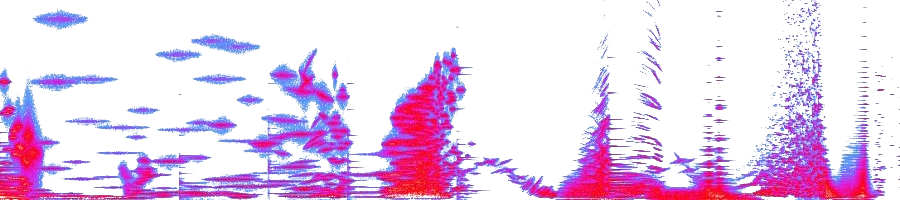
Solo Pour Deux (1981) di Grisey, per clarinetto e trombone, incarna l’essenzialità della concezione compositiva spettrale e in questo senso è didattico.
Come il titolo suggerisce, i due strumenti (monofonici) non creano contrasti o linee melodiche contrappuntistiche, ma concorrono a creare la sonorità di questo brano lavorando l’uno sugli armonici dell’altro (tipicamente il clarinetto su quelli del trombone, per forza di cose). Sono in due, ma, nella maggior parte dei casi, creano un’unica linea, spesso sovrapponendosi, ma a volte l’uno continua riducendo o espandendo una nota dell’altro.
Sotto l’aspetto dell’idea compositiva (ma solo in quello), il pezzo è vicino al Ko-Lho per flauto e clarinetto di (o attribuito a) Giacinto Scelsi del 1966, che potete ascoltare qui, soprattutto al secondo movimento, in cui i due strumenti, più che duettare, si compenetrano.
Presumibilmente gli interpreti sono Ernesto Molinari al clarinetto e Uwe Dierksen al trombone.
The title Vortex Temporum indicates the beginning of the system of rotation, repeated arpeggios and their metamorphosis in various transient passages. The problem here is to enter the depths of my recent research on the use of the same material at different times. The three basic forms are the original event – a sinusoidal wave – and two continuous events, an attack with or without resonance as well as a sound held with or without crescendo. There are three various spectra: harmonics, ‘stretched disharmonics’ and ‘compressed disharmonics’; three different tempos: basic, more or less expanded, and more or less contracted. These are the archetypes that guide Vortex Temporum.
In addition to the initial introductory vibration formula taken directly from Daphnis et Chloe, ‘Vortex’ suggested to me harmonic writings focused around the four tones of the diminished seventh chord, a rotational chord par excellence. Treating each of these tones as leading ones, we obtain the possibility of multiple modulations. Of course, we aren’t dealing here with the tonal system but rather with considerations of what might still be relevant and innovative in this system. The chord about which I’m speaking is thus a common part of the three previously written spectra and determines other displacements.
The piano used in the work is tuned a quarter tone lower, which changes the sound of the instrument, at the same time facilitating the integration within microintervals, which are essential in this work. In Vortex Temporum the three archetypes described above revolve around one fragment and the other in temporary intervals, differing among themselves as among people (the tempo of speech and breathing), whales (spectral time of sleeping rhythms), and birds or insects (extremely contracted time, whose contours become obliterated). Thanks to this imagined microscope, the notes become sound, a chord becomes a spectral complex, and rhythm transforms into a wave of unexpected duration.
The three portions of the first part, dedicated to Gérard Zinsstag, develop three aspects of the original wave, well known to acoustic engineers: the sinusoidal wave (vibration formula); the square wave (dotted rhythm) and the jagged wave (piano solo). They develop the tempo, which can be defined as ‘joyful’, the tempo of articulation, rhythm of human breathing. The isolated piano section reaches the boundaries of virtuosity.
The second part, dedicated to Salvatore Sciarrino, approaches the same material in expanded time. Initial Gestalt appears here only once, spreading throughout the entire part. I tried here to create the feeling of the confused speed inside the slow tempo.
Part three, dedicated to Helmut Lachenmann, introduces a long process allowing the creation of interpolation, which appears between the various sequences. Continuity gradually establishes, and expands, finally becoming a kind of widely conceived projection of the events from the first part. The spectra originally developed in the harmonic discourse of part two expand here to an extent degree, enabling the listener to detect the structure and entrance into other time dimension.
Short interludes are planned between the parts of Vortex Temporum. A few breaths, noises and discrete noises colour the awkward silence, and even the discomfort of the musicians and listeners, who hear their own breathing between he parts. Treating waiting time this way, linking the time of the audience with the time of the work, refers to some of my earlier works, for example Dérives, Partiels or Jour, Contrejour. Here, of course, these tiny noises are allied with the morphology of Vortex Temporum.
Overthrowing the material in favor of pure endurance is a dream, which I have been carrying out for many years. Vortex Temporum is perhaps only a history of the arpeggio in time and space – from the point of view of our ears.
Vortex Temporum was commissioned by the French Ministry of Culture, Ministerium für Kunst Baden-Würtemberg and the Westdeutsche Rundfunk Köln, at the special request of ‘Ensemble Recherche’.
Dérives, composto da Gérard Grisey nel 1973-74, è insieme a Périodes e Partiels, una delle composizioni seminali per il movimento della musica spettrale.
In questo brano per due gruppi orchestrali, una sinfonietta e un’orchestra completa (interessante notare che nell’ensemble c’è anche una chitarra elettrica), si applica una tecnica che può essere definita come sintesi additiva strumentale, in cui gli strumenti arrivano a comporre una timbrica mediante la somma di molte componenti. Si parla di timbrica e non di armonia perché è in questo senso che l’indieme sonoro è concepito, al punto che agli strumenti è spesso richiesta una intonazione sugli armonici di un suono base e non sulla scala temperata.
Il suono come generatore della forma globale, secondo la poetica dello spettralismo espressa da questa dichiarazione programmatica dello stesso Grisey:
We are musicians and our model is sound not literature, sound not mathematics, sound not theatre, visual arts, quantum physics, geology, astrology or acupuncture
[cit. in Fineberg, Joshua (2006). Classical Music, Why Bother?: Hearing the World of Contemporary Culture Through a Composer’s Ears. Routledge. ISBN-10: 0415971748, ISBN-13: 978-0415971744]
E ancora:
Spectralism is not a system. It’s not a system like serial music or even tonal music. It’s an attitude. It considers sounds, not as dead objects that you can easily and arbitrarily permutate in all directions, but as being like living objects with a birth, lifetime and death. This is not new. I think Varese was thinking in that direction also. He was the grandfather of us all. The second statement of the spectral movement — especially at the beginning — was to try to find a better equation between concept and percept — between the concept of the score and the perception the audience might have of it. That was extremely important for us.
Pubblico la traduzione delle note di programma scritte dallo stesso Gérard Grisey per “Les Chants de l’Amour” (vedi post precedente). Scusate la forma un po’ involuta, ma, data la lunghezza, le ho tradotte con babelfish, correggendo poi i punti errati (devo dire che babelfish se la cava piuttosto bene dal francese all’italiano).
Les Chants de l’Amour – Note di programma di Gérard Grisey
Il primo progetto de “Les Chants de l’Amour”, in realtà la messa in atto formale, data dell’estate 1981. Io concepiti allora l’idea di grandi polifonie vocali avvolte e sostenute da una fondamentale potente. Il programma CHANT concepito alla IRCAM, di cui avevo allora ascoltato alcuni esempi, mi apparì immediatamente come lo strumento adeguato per realizzare questa voce continua e queste pulsazioni respiratorie, vero liquido amniotico delle voci umane.
All’origine dei “Les Chants de l’Amour”, non c’è nessun testo particolare, bensì piuttosto un materiale fonetico così costituito:
Un’introduzione che contiene la dedica del brano in dieci lingue diverse (“canti d’amore dedicati a tutti gli amanti della terra”);
Le diverse vocali contenute nella frase “I love you”. Così sedici vocali diverse per i cantanti ed un centinaio di vocali per la voce sintetizzata;
Diverse consonanti che appaiono gradualmente nel corso del brano.
I nomi di amanti famosi: Tristan, isolde, Orfeo, Euridice, don Quichote, Dulcinea, Romeo, Giuletta…
Litanie attorno alla parola amore, composte in francese, inglese, tedesco ed ungherese, soprattutto per la loro sonorità;
Interiezioni, sospiri, scoppi di risa, halètements, gemiti, pezzetti di frasi, soprattutto per il loro carattere erotico;
“Ti amo”, “Amant”, “amore” registrati in 22 lingue diverse, materiale fonetico per la folla e fonte concreta destinata a essere trattata dall’elaboratore;
Un estratto “di Rayuela”di Cortazar;”
La frase “I love you” base formale semantica di tutta la parte.
Ossia nel totale 28 sezioni, facilmente reperibili poiché ciascuna di essa possiede la stessa forma respiratoria.
La parte elettronica de “Les Chants de l’Amour” proviene principalmente da due fonti sonore: la voce sintetizzata dal programma CHANT e voci parlate registrate, digitalizzate e quindi trattate dall’elaboratore, soprattutto con una serie di filtri. L’interesse della voce sintetica non risiede tanto nell’imitazione della voce umana quanto nelle possibilità infinite di deviazione di queste voci. Vi scopriamo molti campi di percezioni e reazioni emotive legate agli avatars della voce umana.
L’altro versante di questa voce sintetica, cantata e tutta vocalizzata, sono la voce parlata, il rumore delle consonanti e della lingua. Solo l’elaboratore poteva permettermi di registrare queste voci diverse, raggrupparle, moltiplicarle e trasporle per creare vere cascate di voce umana, turbinio di folle ai quattro punti cardinali che vanno ripetendo “Ti amo” nella diversità dei loro timbri e delle loro lingue.. Nel corso di “Les Chants de l’Amour” evolvono vari tipi di relazioni tra le dodici voti del coro e tra il coro come entità e la voce della macchina. Questa voce, a sua volta, divina, enorme, minacciando, seduttrice, specchio e proiezione di tutti i fantasmi delle voci umane, si sdoppia e si moltiplica fino alla folla.
La scrittura delle parti affidate ai 12 cantanti è basata non su delle parole, ma su vocali e dittonghi estratti dalla analisi spettrale della frase “I love you”. Vengono inoltre utilizzate alcune interiezioni sonore come sospiri, scoppi di risa o frammenti della stessa frase.
La parte elettronica è stata sintetizzata all’IRCAM mediante il programma “Chant”, la cui caratteristica è di creare delle vocali artificiali molto malleabili che agiscono a tratti da collante, a tratti come elemento complementare o di contrasto rispetto alle voci reali.
Intelligentemente, Grisey utilizza le vocali anche nella maggioranza delle parti cantate, riuscendo così a fondere le voci reali con i materiali generati dal programma.
“Vedo i suoni come fasci di forza orientati nel tempo, infinitamente mobili e fluttuanti”.
La lezione di Stimmung è presente e Grisey la supera, inventando un brano estremamente mobile, con una scrittura a tratti quasi pirotecnica, che unisce i tratti fondamentali dello spettralismo a una notevole forza espressiva.
Gérard Grisey – Quatre chants pour franchir le seuil per soprano e 15 strumenti (1996-1997).
Quasi una premonizione, l’ultima composizione di Grisey che morirà nel 1998.
Ho concepito i Quattro Canti per superare la soglia come una meditazione musicale sulla morte in quattro aspetti: la morte dell’angelo, la morte della civilizzazione, la morte della voce e la morte dell’umanità. I quattro movimenti sono separati da brevi interludi, polveri sonore morbide, destinati a mantenere un livello di tensione leggermente superiore al silenzio educato ma rilassato che regna nelle sale di concerto tra la fine di un movimento e l’inizio del seguente. I testi scelti appartengono a quattro civilizzazioni (cristiana, egiziana, greca, mesopotamia) ed hanno in comune un discorso frammentario sull’inevitabile della morte. La scelta della formazione è stata dettata dall’esigenza musicale di opporre alla leggerezza della voce di soprano una massa grave, pesante e tuttavia suntuosa e colorata.
I 4 canti:
Prelude: La mort de l’ange – D’après Les heures de la nuit de Christian Guez-Ricord
Interlude: La mort de la civilisation – D’après les Sarcophages égyptiens du Moyen Empire
Interlude: La mort de la voix – D’après Erinna
Faux Interlude: La mort de l’humanite – D’après L’Épopée de Gilgamesh
Il testo della prima parte, tratto da Les Heures de la Nuit di Christian Guez-Ricord (La Sétérée, Jacques Clerc Editeur, 1992)
De qui se doit de mourir comme un ange ……………….
comme il se doit de mourir comme un ange je me dois de mourir moi-même
il se doit son mourir son ange est de mourir comme il s’est mort comme un ange