 UBUWeb ha pubblicato vari scritti di La Monte Young fra cui Selected Writings 1959-69 e la famosa Anthology of Chance Operations del 1963.
La partitura in figura è il Keyboard Study #2 di Terry Riley del 1967.
UBUWeb ha pubblicato vari scritti di La Monte Young fra cui Selected Writings 1959-69 e la famosa Anthology of Chance Operations del 1963.
La partitura in figura è il Keyboard Study #2 di Terry Riley del 1967.
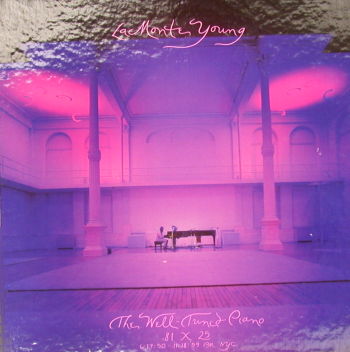
The Well-Tuned Piano (iniziato nel 1964, eseguito in prima assoluta a Roma nel 1974 e in fondo sempre in progress) è l’opus magnum di La Monte Young, il lavoro in cui molte delle sue teorie si cristallizzano e prendono forma.
Un pianoforte, il vecchio Bosendorfer dello stesso La Monte Young accordato secondo una delle possibili varianti della scala naturale (just intonation) assume sonorità molto particolari. L’accordatura esatta rimase segreta per 27 anni, fino a quando, nel 1991, Kyle Gann ne decodificò 10 note su 12 usando un computer, un DX7 e un CD player.
Perché solo 10? Perché una nota (il SOL#) non viene mai utilizzata e un’altra, il DO#, appare solo una volta in più di 5 ore di esecuzione. Comunque, a questo punto, l’accordatura venne resa nota e risultò essere come segue (riporto la tabella dal link di cui sopra, aggiungendo una riga):
| Notes: | Eb | E | F | F# | G | G# | A | Bb | B | C | C# | D |
|---|---|---|---|---|---|---|---|---|---|---|---|---|
| Ratios: | 1/1 | 567/ 512 |
9/8 | 147/ 128 |
21/ 16 |
1323/ 1024 |
189/ 128 |
3/2 | 49/ 32 |
7/4 | 441/ 256 |
63/ 32 |
| Cents: | 0 | 177 | 204 | 240 | 471 | 444 | 675 | 702 | 738 | 969 | 942 | 1173 |
| Temp Cents: | 0 | 100 | 200 | 300 | 400 | 500 | 600 | 700 | 800 | 900 | 1000 | 1100 |
Come si può notare osservando la linea “Cents”, che rappresenta l’accordatura delle singole note espresse in centesimi di semitono (100 cents = 1 semitono temperato), le differenze con l’accordatura temperata (quella comunemente usata, espressa nella linea “Temp Cents”) sono notevoli. Praticamente soltanto la 5a e la 2a maggiore sono invariate.
Vale la pena di ricordare che l’accordatura naturale (just intonation) si ottiene trasponendo all’interno dell’ottava gli armonici naturali. Il punto è che la maggior parte delle note si possono ottenere partendo da parecchi armonici, con intonazione leggermente diversa. La scelta determina la qualità della scala e il grado di frizione degli accordi costruita su di essa.
La sonorità della scala naturale, comunque, è migliore rispetto alla scala temperata (più naturale, appunto). Il prezzo da pagare, però, è immenso, almeno dal punto di vista della musica occidentale: funziona bene solo in una, massimo due tonalità. Addio alle modulazioni, che invece sono una pratica fondamentale nella nostra musica.
In questo estratto di alcuni minuti (sulle quasi 6 ore dell’opera), tratto dalla sezione iniziale, si può sentire come La Monte Young la utilizzi per costruire dapprima armonie ripetitive e poi nuvole di suoni a pedale quasi sempre premuto, dando vita a una serie infinita di risonanze che avvolgono l’intera trama.
La Monte Young – The Well-Tuned Piano (excerpt from section 1)
 Difficile scrivere poche righe su La Monte Young.
Nato nel 1935, considerato come uno dei primi minimalisti e celebrato dalla suddetta scuola, sebbene formalmente abbia molto poco in comune con compositori come Glass e Reich, i suoi lavori sono considerati fra i più importanti e radicali nel panorama dell’avanguardia post-bellica e sperimentale.
Ispiratore del gruppo Fluxus, le sue composizioni concettualmente minimali investono la stessa definizione di musica. Molti dei suoi pezzi, infatti, sono costituiti da un eterno bordone.
Ricordo che, nella mia ormai lontana gioventù, 8) rimasi colpito da una sua partitura costituita unicamente da due note in 5a (mi pare SI e FA#), con la scritta “to be held for a long time”. Probabilmente il brano più lungo con la partitura più corta mai composto.
Rimasi anche colpito da una sua riflessione che investiva la nostra considerazione del tempo:
Se un giro di blues dura 12 battute, perché non può durare 12 giorni? 4 giorni in DO, 2 giorni in FA…..
Autore del Well Tuned Piano (il pianoforte ben temperato), un’opera monumentale per piano solo accordato secondo la scala naturale (just intonation), la cui durata in alcune esecuzioni supera le 6 ore ed è documentata in una edizione in 5 CD da Grammavision (e poi in DVD per la sua etichetta Just Dreams), è stato un pioniere dello studio degli effetti generati da intervalli musicali naturali mantenuti a lungo e insieme con Marian Zazeela ha realizzato una serie di Dream Houses, ambienti in cui si combinano i suoi tappeti di onde sinusoidali in just intonation con le sculture di luce in forme simmetriche e quasi calligrafiche di Zazeela.
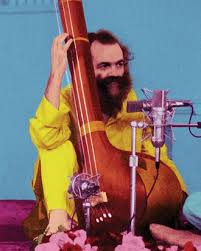
Ha anche studiato musica classica indiana con Pandit Pran Nath a cui è dedicato questo brano composto unicamente da un bordone di tampura e messo in linea da AnaBlog.
È lungo e sempre uguale e ricordate, se un suono non vi piace è perché non l’avete ascoltato abbastanza.
La Monte Young – The Tamburas of Pandit Pran Nath