Musica Arte Tecnologia Storie Estreme

1

Mar

La voce di un poeta

Scritto da:Mauro @ 2008.03.01.00.01.02 — Archiviato in: Letteratura

La voce di un grande poeta è maledettamente emozionante.

Dylan Thomas legge la sua And death shall have no dominion, pubblicata nel 1936 in Twenty-five poems.

And death shall have no dominion, read by Dylan Thomas itself.

Dylan Thomas - And death shall have no dominion (1936)

And death shall have no dominion.
Dead men naked they shall be one
With the man in the wind and the west moon;
When their bones are picked clean and the clean bones gone,
They shall have stars at elbow and foot;
Though they go mad they shall be sane,
Though they sink through the sea they shall rise again;
Though lovers be lost love shall not;
And death shall have no dominion.

And death shall have no dominion.
Under the windings of the sea
They lying long shall not die windily;
Twisting on racks when sinews give way,
Strapped to a wheel, yet they shall not break;
Faith in their hands shall snap in two,
And the unicorn evils run them through;
Split all ends up they shan’t crack;
And death shall have no dominion.

And death shall have no dominion.
No more may gulls cry at their ears
Or waves break loud on the seashores;
Where blew a flower may a flower no more
Lift its head to the blows of the rain;
Though they be mad and dead as nails,
Heads of the characters hammer through daisies;
Break in the sun till the sun breaks down,
And death shall have no dominion.

E la morte non avrà più dominio.
I morti nudi saranno una cosa
Con l’uomo nel vento e la luna d’occidente;
Quando le loro ossa saranno spolpate e le ossa pulite scomparse,
Ai gomiti e ai piedi avranno stelle;
Benché impazziscano saranno sani di mente,
Benché sprofondino in mare risaliranno a galla,
Benché gli amanti si perdano l’amore sarà salvo;
E la morte non avrà più dominio.

E la morte non avrà più dominio.
Sotto i meandri del mare
Giacendo a lungo non moriranno nel vento;
Sui cavalletti contorcendosi mentre i tendini cedono,
Cinghiati ad una ruota, non si spezzeranno;
Si spaccherà la fede in quelle mani
E l’unicorno del peccato li passerà da parte a parte;
Scheggiati da ogni lato non si schianteranno;
E la morte non avrà più dominio.

E la morte non avrà più dominio.
Più non potranno i gabbiani gridare ai loro orecchi,
Le onde rompersi urlanti sulle rive del mare;
Dove un fiore spuntò non potrà un fiore
Mai più sfidare i colpi della pioggia;
Ma benché pazzi e morti stecchiti,
Le teste di quei tali martelleranno dalle margherite;
Irromperanno al sole fino a che il sole precipiterà;
E la morte non avrà più dominio.

Tags: ,

Related posts

4

Oct

Alla nuova luna

Scritto da:Mauro @ 2007.10.04.17.36.49 — Archiviato in: Letteratura, Storia, Tecnologia

Una poesia di Quasimodo (da “La terra impareggiabile”, 1958) scritta in occasione del lancio dello Sputnik-I, prima Luna artificiale.

Alla nuova Luna

In principio Dio creò il cielo
e la terra, poi nel suo giorno
esatto mise i luminari in cielo,
e al settimo giorno si riposò.
Dopo miliardi di anni l’uomo,
fatto a sua immagine e somiglianza,
senza mai riposare, con la sua
intelligenza laica,
senza timore, nel cielo sereno
d’una notte d’ottobre,
mise altri luminari uguali
a quelli che giravano
dalla creazione del mondo. Amen.

Tags:

Related posts

30

Sep

Myanmar

Scritto da:Mauro @ 2007.09.30.00.01.35 — Archiviato in: Letteratura, Musica, Viaggi

arpa birmana

Un pensiero per la Birmania.

Hman Nyaung Thin Zar eseguita da Alinka Kyaw Swa U Ba Than (1906, 1987)

Uno dei brani più famosi della musica classica birmana. Anticamente veniva eseguito a palazzo reale e nelle occasioni in cui il re si rivolgeva al popolo.
E mentre ascoltate leggetevi

Rudyard Kipling, Mandalay

che avrà anche degli accenti un po’ nefandi, da romantico colonialismo d’altri tempi e a tratti è buffa, però ha rappresentato per molto tempo la Birmania nell’immaginario occidentale…

By the old Moulmein Pagoda, lookin’ eastward to the sea,
There’s a Burma girl a-settin’, and I know she thinks o’ me;
For the wind is in the palm-trees, and the temple-bells they say:
“Come you back, you British soldier; come you back to Mandalay!”
Come you back to Mandalay,
Where the old Flotilla lay:
Can’t you ‘ear their paddles chunkin’ from Rangoon to Mandalay?
On the road to Mandalay,
Where the flyin’-fishes play,
An’ the dawn comes up like thunder outer China ‘crost the Bay!

‘Er petticoat was yaller an’ ‘er little cap was green,
An’ ‘er name was Supi-yaw-lat — jes’ the same as Theebaw’s Queen,
An’ I seed her first a-smokin’ of a whackin’ white cheroot,
An’ a-wastin’ Christian kisses on an ‘eathen idol’s foot:
Bloomin’ idol made o’mud –
Wot they called the Great Gawd Budd –
Plucky lot she cared for idols when I kissed ‘er where she stud!
On the road to Mandalay . . .

When the mist was on the rice-fields an’ the sun was droppin’ slow,
She’d git ‘er little banjo an’ she’d sing “Kulla-lo-lo!”
With ‘er arm upon my shoulder an’ ‘er cheek agin’ my cheek
We useter watch the steamers an’ the hathis pilin’ teak.
Elephints a-pilin’ teak
In the sludgy, squdgy creek,
Where the silence ‘ung that ‘eavy you was ‘arf afraid to speak!
On the road to Mandalay . . .

But that’s all shove be’ind me — long ago an’ fur away,
An’ there ain’t no ‘busses runnin’ from the Bank to Mandalay;
An’ I’m learnin’ ‘ere in London what the ten-year soldier tells:
“If you’ve ‘eard the East a-callin’, you won’t never ‘eed naught else.”
No! you won’t ‘eed nothin’ else
But them spicy garlic smells,
An’ the sunshine an’ the palm-trees an’ the tinkly temple-bells;
On the road to Mandalay . . .

I am sick o’ wastin’ leather on these gritty pavin’-stones,
An’ the blasted Henglish drizzle wakes the fever in my bones;
Tho’ I walks with fifty ‘ousemaids outer Chelsea to the Strand,
An’ they talks a lot o’ lovin’, but wot do they understand?
Beefy face an’ grubby ‘and –
Law! wot do they understand?
I’ve a neater, sweeter maiden in a cleaner, greener land!
On the road to Mandalay . . .

Ship me somewheres east of Suez, where the best is like the worst,
Where there aren’t no Ten Commandments an’ a man can raise a thirst;
For the temple-bells are callin’, an’ it’s there that I would be –
By the old Moulmein Pagoda, looking lazy at the sea;
On the road to Mandalay,
Where the old Flotilla lay,
With our sick beneath the awnings when we went to Mandalay!
On the road to Mandalay,
Where the flyin’-fishes play,
An’ the dawn comes up like thunder outer China ‘crost the Bay!

Tags:

Related posts

16

Jun

Canti di Innocenza e di Esperienza

Scritto da:Mauro @ 2007.06.16.00.01.43 — Archiviato in: Letteratura

Tyger
I Canti di Innocenza e di Esperienza di William Blake (28 novembre 1757 - 12 agosto 1827), poeta e artista visionario inglese possono essere scaricati liberamente da Project Gutenberg o ascoltati all’Internet Archive grazie a Librivox.

The Songs of Innocence and ExperienceWilliam Blake (November 28, 1757 – August 12, 1827) was an English poet, visionary, painter, and printmaker. Largely unrecognized during his lifetime, Blake’s work is today considered seminal and significant in the history of both poetry and the visual arts. He was voted 38th in a poll of the 100 Greatest Britons organized by the BBC in 2002.
You can freely download The Songs of Innocence and Experience from Project Gutenberg or listen in audio form from Librivox at the Internet Archive.

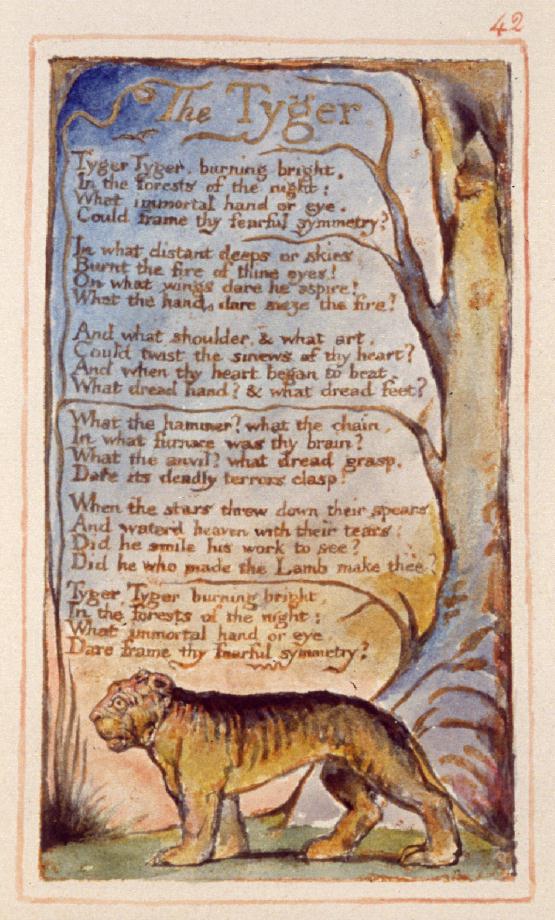
Immagine ingrandita / Larger Image

Ascolta / Listen to
The Tyger
Read by: Gord Mackenzie

The Tyger


Tyger ! Tyger! Burning bright
In the forests of the night,
What immortal hand or eye
Could frame thy fearful symmetry?

In what distant deeps or skies
Burnt the fire of thine eyes?
On what wings dare he aspire?
What the hand dare seize the fire?
And what shoulder, and what art,
Could twist the sinews of thy heart?
And when thy heart began to beat,
What dread hand? And what dread feet?

What the hammer? What the chain?
In what furnace was thy brain?
What the anvil? What dread grasp
Dare its deadly terrors grasp?

When the stars threw down their spears,
And water’d heaven with their tears
Did he smile his work to see?
Did he who made the Lamb make thee?

Tyger! Tyger! Burning bright
In the forests of the night,
What immortal hand or eye,
Dare frame thy fearful symmetry?

La Tigre
traduzione di G.Ungaretti


Tigre! Tigre! Divampante fulgore
Nelle foreste della notte,
Quale fu l’immortale mano o l’occhio
Ch’ebbe la forza di formare la tua agghiacciante simmetria?

In quali abissi o in quali cieli
Accese il fuoco dei tuoi occhi?
Sopra quali ali osa slanciarsi?
E quale mano afferra il fuoco?
Quali spalle, quale arte
Poté torcerti i tendini del cuore?
E quando il tuo cuore ebbe il primo palpito,
Quale tremenda mano? Quale tremendo piede?

Quale mazza e quale catena?
Il tuo cervello fu in quale fornace?
E quale incudine?
Quale morsa robusta osò serrarne i terrori funesti?

Mentre gli astri perdevano le lance tirandole alla terra
e il paradiso empivano di pianti?
Fu nel sorriso che ebbe osservando compiuto il suo lavoro,
Chi l’Agnello creò, creò anche te?

Tigre! Tigre! Divampante fulgore
Nelle foreste della notte,
Quale mano, quale immortale spia
Osa formare la tua agghiacciante simmetria?

Tags:

Related posts

30

Apr

LibriVox

Scritto da:Mauro @ 2007.04.30.00.01.11 — Archiviato in: Letteratura

lapide

LibriVox is a hope, an experiment, and a question: can the net harness a bunch of volunteers to help bring books in the public domain to life through podcasting?
LibriVox volunteers record chapters of books in the public domain and release the audio files back onto the net. Our goal is to make all public domain books available as free audio books. We are a totally volunteer, open source, free content, public domain project.

Per chi ama la poesia in lingua originale, segnalo LibriVox, un sito il cui sottotitolo dice tutto: acoustical liberation of books in the public domain.
LibriVox offre un vasto catalogo di letture di testi i cui diritti sono ormai scaduti. La maggior parte è in inglese perché sono loro ad avere questa bella tradizione del reading poetico. Ma non c’è solo poesia, anche romanzi, saggi e testi di tutti i tipi.

From LibriVox
Henry Wadsworth Longfellow - The Siege of Kazan - Read by: Peter Yearsley


Black are the moors before Kazan,
And their stagnant waters smell of blood:
I said in my heart, with horse and man,
I will swim across this shallow flood.
longfellow
Under the feet of Argamack,
Like new moons were the shoes he bare,
Silken trappings hung on his back,
In a talisman on his neck, a prayer.

My warriors, thought I, are following me;
But when I looked behind, alas!
Not one of all the band could I see,
All had sunk in the black morass!

Where are our shallow fords? and where
The power of Kazan with its fourfold gates?
From the prison windows our maidens fair
Talk of us still through the iron grates.

We cannot hear them; for horse and man
Lie buried deep in the dark abyss!
Ah! the black day hath come down on Kazan!
Ah! was ever a grief like this?

Tags:

Related posts

26

Nov

Do not go gentle into that good night

Scritto da:Mauro @ 2006.11.26.00.01.29 — Archiviato in: Audio, Letteratura

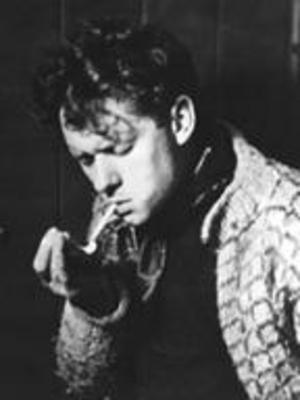
Dylan ThomaL’esperienza che vi propongo qui è sempre audio, ma è un po’ diversa dal solito.
Noi non abbiamo la consuetudine della lettura di poesia. Gli anglosassoni, invece, ce l’hanno ed è una gran cosa, soprattutto quando a leggere sono gli stessi autori.
Recentemente, Salon.com ha messo in linea tutta la Caedmon Collection, una serie di registrazioni eseguite fra il 1952 e il ‘53, in cui Dylan Thomas legge una vasta selezione della propria poesia e prosa, insiema a qualche brano dei suoi autori preferiti, fra cui Shakespeare, Milton, Eliot, Auden, Hardy, Lawrence, Graves e il suo amico Vernon Watkins.
Da questa raccolta, ecco la famosissima “Do not go gentle into that good night”, dedicata al padre morente, letta da lui stesso.
L’impostazione vocale di Dylan Thomas è chiara e diretta, di grande potenza, ma con molte sfumature espressive. D’altronde, i suoi reading erano affollatissimi e la gente rimaneva fuori dai teatri o dai cinema in cui il poeta si esibiva, per mancanza di posto.

Ascolta Dylan Thomas

Do not go gentle into that good night,
Old age should burn and rave at close of day;
Rage, rage against the dying of the light.
Non andartene docile in quella buona notte,
vecchiaia dovrebbere ardere e infierire
quando cade il giorno;
infuria, infuria contro il morire della luce.
Though wise men at their end know dark is right,
Because their words had forked no lightning they
Do not go gentle into that good night.
Benché i saggi sappiano infine che il buio è giusto,
poiché dalle parole loro non diramò alcun conforto,
non se ne vanno docili in quella buona notte.
Good men, the last wave by, crying how bright
Their frail deeds might have danced in a green bay,
Rage, rage against the dying of the light.
I buoni, che in preda all’ultima onda
splendide proclamano le loro fioche imprese,
avrebbero potuto danzare in una verde baia,
e infuriano, infuriano contro il morire della luce.
Wild men who caught and sang the sun in flight,
And learn, too late, they grieved it on its way,
Do not go gentle into that good night.
I selvaggi, che il sole al volo presero e cantarono,
tardi apprendono come lo afflissero nella sua via,
non se ne vanno docili in quella buona notte.
Grave men, near death, who see with blinding sight
Blind eyes could blaze like meteors and be gay,
Rage, rage against the dying of the light.
Gli austeri, vicini a morte, con cieca vista scorgono
che i ciechi occhi quali meteore potrebbero brillare
ed essere gai; e infuriano
infuriano contro il morire della luce.
And you, my father, there on the sad height,
Curse, bless, me now with your fierce tears, I pray.
Do not go gentle into that good night.
Rage, rage against the dying of the light.
E te, padre mio, là sulla triste altura io prego,
maledicimi, feriscimi con le tue fiere lacrime.
Non andartene docile in quella buona notte,
infuria, infuria contro il morire della luce.
Tags: ,

Related posts